
Remote online notarization lets a borrower sign and notarize loan documents from anywhere via live audiovisual session, and for brokers the real question isn't whether it works. It's whether your state, your county recorder, and your investor will accept it. Adopt RON when all three say yes, use a MISMO-compliant vendor, and route only the security instrument, not every closing document, through the RON channel.
TL;DR:
- Remote online notarization is only viable if both your state and county recorder accept it, and your investor approves the specific transaction and documents.
- Confirm all legal, county, investor, and document eligibility checks before scheduling a remote closing to avoid delays or inability to record or sell the loan.
- A phased rollout starting with e-signatures, then hybrid, and finally full RON minimizes technological and process friction, emphasizing staff training and compliance.
- RON standards require compliance with MISMO, Ginnie Mae, and investor policies, including retaining recordings for at least 10 years and verifying document types.
- Integrating RON into existing loan origination and closing systems reduces failure points, especially when building mandatory checks into the LOS as hard stops before scheduling.
Table of Contents
- What Is Remote Online Notarization for Mortgage Closings?
- Can Your Loan Use RON Today? A Readiness Checklist
- How Do You Move From E-Sign to Full RON?
- What Compliance Rules Govern RON for Investors?
- How Do You Integrate RON Into Your LOS and Closing Stack?
- Why County Recorders Matter More Than State Law
- What Audit Trail and Retention Records Do You Need?
- The Six-Point Intake Check You Can Build Into Your LOS
- Practitioner Perspective: What Actually Breaks RON Rollouts
- How 1 Solution Helps Brokers Build RON Capability
- Sources
What Is Remote Online Notarization for Mortgage Closings?
Remote online notarization (RON) is a legal process where a commissioned notary verifies a signer's identity and witnesses a signature over live video, then applies an electronic notarial seal to the document. That's distinct from consumer-facing video notary apps built for wills or affidavits. In mortgage lending, RON has to survive a much harder test: the note or security instrument has to be recordable at the county level, deliverable to a GSE or investor, and defensible in an audit years later.
Forty-five states and D.C. now permit RON for real estate financial transactions, according to Mortgage Bankers Association tracking. Connecticut specifically excludes RON for real estate closings, and a handful of states still haven't passed enabling statutes. That patchwork is exactly why "RON is legal" isn't a useful checkbox. "RON is legal for this loan, in this county, for this investor" is the only version that matters.

Can Your Loan Use RON Today? A Readiness Checklist
Run this at intake, before you promise a borrower a remote closing:
- State authorization: confirm your origination state and the notary's commissioning state both permit RON, and check for carve-outs like Connecticut's real estate exclusion.
- County e-recording: call or check the recorder's published list. Not every county accepts remotely notarized instruments even where state law allows RON.
- Investor acceptance: verify your warehouse lender and end investor's current RON policy, including Fannie Mae's delivery requirements.
- Document eligibility: confirm the specific document qualifies under UETA/ESIGN. Some instruments, like certain powers of attorney or trust documents, carry exclusions.
- Notary and storage readiness: confirm the notary is properly registered for RON and your systems can store the audit trail.
Miss any one of these and you're not looking at a delay. You're looking at a loan that can't be recorded or sold.
How Do You Move From E-Sign to Full RON?
A phased rollout beats a big-bang switch almost every time, mainly because the friction in RON adoption is rarely the technology. It's the people and processes around it.
- Phase 1, e-sign: Pick an e-signature vendor and map it cleanly into your LOS before adding any notarization complexity. This is also where you evaluate e-signature platform options built for mortgage workflows specifically.
- Phase 2, hybrid: Pilot RON on a limited set of loans in a single state or county. Track time-to-close, re-note rates, and settlement-agent feedback closely. Industry surveys show cost, integration limits, and staff training remain the primary barriers to eClose adoption, so measure for those specifically.
- Phase 3, full RON: Scale only once you've confirmed investor and county coverage across your footprint, not just in your pilot market.
Change management runs alongside every phase. Train loan officers on what RON can and can't do, and loop in settlement agents and title companies early. A structured rollout plan prevents the scenario where your team promises RON to a borrower before your county even accepts it.
What Compliance Rules Govern RON for Investors?
Investor and standards-body requirements are where well-intentioned RON programs stall. Four sets of rules matter most:
- MISMO RON Standards V2 set baseline expectations for identity verification, audit-event logging, session recordings, and vendor information disclosure, according to MISMO's published standards.
- Fannie Mae and Freddie Mac will purchase loans with remotely notarized security instruments, but only when the property state permits RON or recognizes out-of-state RON matching the notary's commission state. Fannie also requires MISMO-compliant vendor data and a Remote Notarization Indicator set at delivery.
- Ginnie Mae's Digital Collateral Program requires RON platforms to comply with MISMO RON Standards and mandates that ceremony recordings be retained, or accessible, for the greater of 10 years or the applicable legal minimum.
- UETA/ESIGN eligibility rules out RON for certain document types entirely, regardless of state RON law.
Statistic worth internalizing: 45 states plus D.C. now permit RON for real estate transactions. That's a strong majority, but it also means roughly one in ten U.S. jurisdictions still creates a compliance trap for brokers who assume nationwide coverage.
How Do You Integrate RON Into Your LOS and Closing Stack?
RON only works at scale if it's wired into systems you already run, not bolted on as a side process. The core integration points are your LOS, document preparation engine, e-sign platform, RON provider's API, eVault, and scheduling tool.
- Routing logic: flag the security instrument specifically and route only that document to the RON provider. Everything else can stay on standard e-sign rails, per practitioner guidance on RON as a routing decision.
- Writeback: build the pipeline so the completed recording, notarial certificate, and audit log flow automatically back into the LOS and eVault, not into a separate folder someone has to remember to check.
- Interoperability: confirm your RON vendor's API supports MISMO delivery indicators and integrates with MERS/eRegistry where applicable.
Pro Tip: Don't route every document to RON just because you can. Treat it as a scalpel, not a hammer, and you'll avoid the scheduling bottlenecks that come from putting an entire closing package through a live video session when only one page legally needs it.
Why County Recorders Matter More Than State Law
State legislatures pass RON statutes. County recorders decide whether they'll actually accept the resulting document, and that gap trips up more brokers than any legal ambiguity does. Even in states with mature RON laws, some counties haven't updated their e-recording systems or require specific metadata formats for remotely notarized instruments, according to reporting on county-level e-recording gaps.
- Call the recorder's office directly and confirm current acceptance of remotely notarized security instruments.
- Ask your title insurer what they require for first-lien enforceability, and flag any exceptions tied to remote notarization.
- Keep a hybrid closing or in-person Remote Ink Notarization (RIN) fallback ready for counties or title insurers that haven't caught up yet.
What Audit Trail and Retention Records Do You Need?
Investors and regulators expect a specific, retrievable package for every RON closing, not a general assurance that "it's documented somewhere." For example, recording and retaining closing ceremony videos is addressed in detail in Mortgage Videos | First Choice Home Loan, highlighting the importance of audit-trail and retention.
- Retention: keep the recording, or maintained access to it, for 10 years or the applicable legal minimum, whichever is longer.
- Audit contents: identity verification evidence, the full audiovisual recording, the signed notarial certificate, and timestamped session logs.
- Delivery flags: the Remote Notarization Indicator and applicable SFC codes must be set correctly before delivery, or expect a kickback.
Statistic worth flagging: that 10 year retention floor isn't a suggestion. It's the minimum Ginnie Mae baseline for any platform facilitating RON, and it should shape your storage architecture from day one, not after your first audit request.
The Six-Point Intake Check You Can Build Into Your LOS
Most RON failures trace back to skipping one of six checks before the closing gets scheduled:
- State legality confirmed for both the property state and the notary's commission state.
- Investor acceptance verified against current GSE or investor policy.
- County recorder e-recording confirmed for the specific document type.
- MISMO-compliant RON vendor available and integrated, per MISMO's standards.
- Audit-retention policy active and storage confirmed for the required period.
- Remote Notarization Indicator set correctly before delivery.
Build these as required LOS fields with a hard stop, not optional checkboxes. If any one field is blank, the loan shouldn't be able to move to closing scheduling. A soft warning gets ignored under deadline pressure. A hard gate doesn't.
Practitioner Perspective: What Actually Breaks RON Rollouts
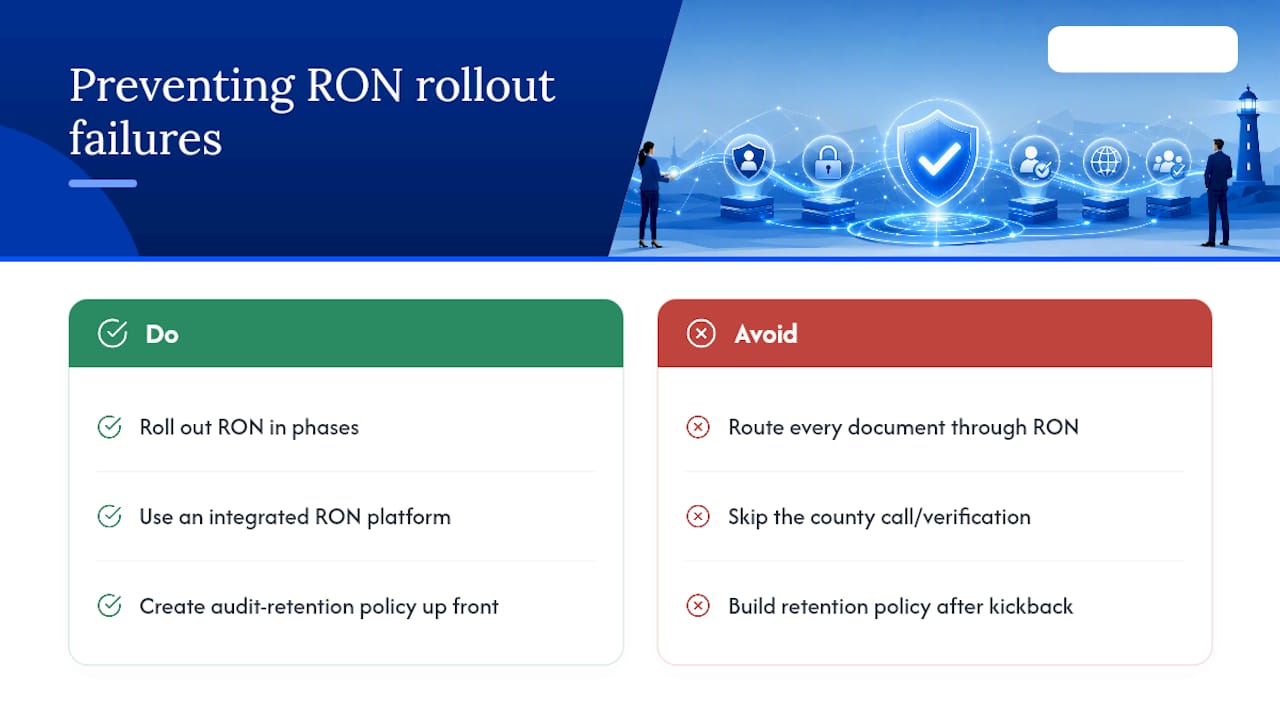
The brokers who struggle with RON almost never fail on the legal research. They fail on discipline: routing every document through RON because the vendor made it easy, skipping the county call because the state law looked clear enough, or building an audit-retention policy after the first investor kickback rather than before it.
Phased rollouts win because they force you to find those failure points on a handful of loans instead of your entire pipeline. An integrated platform reduces the coordination tax of RON adoption by keeping routing rules, audit storage, and delivery flags in one system instead of stitched across five vendors.
— Omar Khamisa
How 1 Solution Helps Brokers Build RON Capability
Most brokers piecing together RON compliance are juggling a separate e-sign tool, a separate RON vendor portal, a spreadsheet for audit retention, and manual delivery-flag checks in the LOS. That's where the coordination overhead actually lives. 1 Solution Mortgage Software was built by mortgage professionals, including founder Omar Khamisa, who spent two decades as a processor, underwriter, loan originator, and systems consultant watching brokers get stuck exactly at this integration seam.
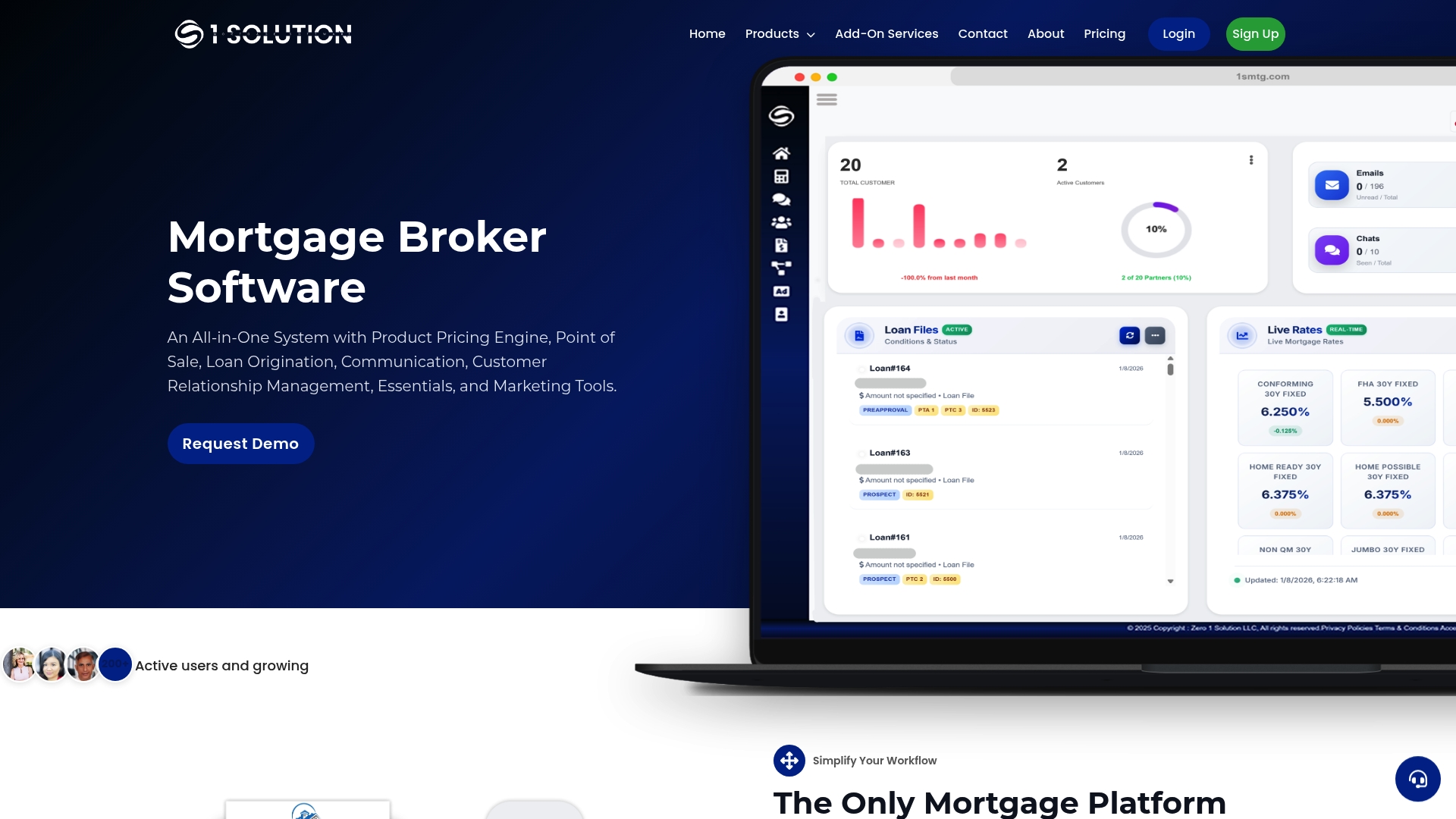
1 Solution centralizes routing logic, audit-trail retention, LOS writeback, and delivery-flag compliance in one connected platform, so your six-point intake check runs inside the same system you already use for pricing, CRM, and closing. As a 100% self-funded independent platform, we built this because we needed it ourselves, not because a boardroom asked for it. If you're ready to see how phased RON adoption looks inside a single system, request a 1 Solution demo and walk through your own loan pipeline with us.
Sources
- Ginnie Mae Digital Collateral Program Guide (June 2024)
- MISMO Remote Online Notarization Standards V2
- Mortgage Bankers Association — Remote Online Notarization resources
- Fannie Mae eClosings / eMortgages FAQ (Fannie Mae)
- The State of eClose Adoption (2023 edition)