
A single source of truth for mortgage operations means one authoritative, continuously updated record for every loan file, so borrower data, disclosures, and pricing never contradict each other across systems. Built around standards like MISMO and delivered through a connected platform like 1 Solution Mortgage Software, it cuts reconciliation work and produces audit-ready files without the manual chasing.
TL;DR:
- Eliminating duplicate data reconciliation across systems can significantly reduce loan cycle times and minimize delays caused by outdated or inconsistent information.
- Building an SSOT should start with a narrow scope focused on high-reconciliation pain points like borrower income and closing disclosures to ensure quick wins.
- Using standards like MISMO and verifiable SMARTDocuments ensures document integrity, time-stamping, and tamper-evidence, simplifying post-close audits.
- Clear ownership, role-based access controls, and immutable audit logs are essential governance measures to maintain data integrity and prepare for compliance reviews.
- A connected platform like 1 Solution Mortgage Software integrates LOS, CRM, and pricing into a single system from the start, avoiding complex and fragile point-to-point integrations.
Table of Contents
- What a Single Source of Truth Looks Like in Mortgage Operations
- Why an SSOT Changes the Numbers That Matter
- How to Build a Practical Single Source of Truth for Mortgage Workflows
- Document Integrity and Standards: MISMO and Verifiable SMARTDocuments
- Governance and Compliance Controls for a Mortgage SSOT
- Common Pitfalls That Derail Mortgage SSOT Projects
- Getting Started: A 30 to 90 Day Checklist for Mortgage Leaders
- Practitioner Perspective: What SSOT Pilots Actually Look Like in Practice
- Why Mortgage Leaders Should Prioritize This Now
- How 1 Solution Mortgage Software Builds Your Single Source of Truth
- Sources
What a Single Source of Truth Looks Like in Mortgage Operations
A system of record just stores data. A single source of truth (SSOT) resolves conflicts between systems and declares one version as authoritative, which is a different job entirely. When your loan origination system says one income figure and your CRM says another, you don't have two data points. You have a broken process.
In mortgage operations, an SSOT usually spans these data domains:
- Borrower identity and income data
- Property and appraisal details
- Underwriting conditions and decisions
- Pricing and lock information
- Disclosures and closing documents
- Servicing transfer records
Most brokerages land on one of three patterns: the LOS as master record with everything else syncing to it, an API-led architecture where a canonical data model sits above all connected systems, or a hybrid where pricing and CRM stay independent but feed a shared reporting layer. The MuleSoft framework for SSOT treats this as a governance decision first, a technology decision second.
Why an SSOT Changes the Numbers That Matter
The case for a single source of truth isn't theoretical. It shows up directly in cycle times, exam outcomes, and funding speed. Fewer re-keys between POS, LOS, and pricing engines means faster loan boarding and fewer closing delays caused by a stale field somewhere downstream.
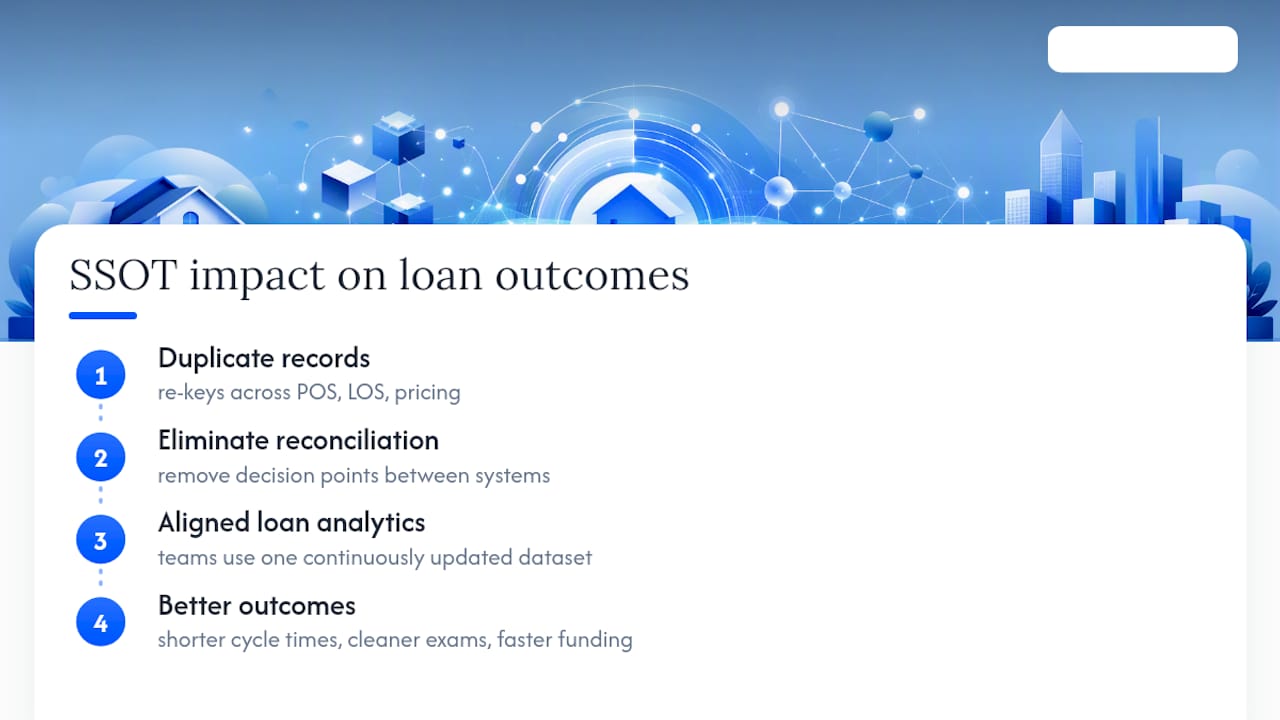
By the numbers: every reconciliation between systems is a moment where a human has to decide which record is correct. Eliminate the duplicate copies, and you eliminate that decision point entirely. That is the entire premise behind aligned loan analytics, which lets risk, servicing, and originations teams work at their own pace off the same continuously updated dataset instead of racing to reconcile competing spreadsheets before a board meeting.
Compliance benefits follow the same logic. Time-stamped, immutable records give examiners a clean trail instead of a scavenger hunt. And on the financial side, fewer loans get kicked back in a buyback review when the investor-facing file matches what the LOS actually shows, which speeds up funding and makes handoffs to the secondary market far less painful.
How to Build a Practical Single Source of Truth for Mortgage Workflows
Building an SSOT is a project with phases, not a switch you flip. Rushing straight to a full data migration is the fastest way to burn six months and end up with a system nobody trusts. Here's a sequence that works:
- Scope it narrow first. Pick the loan fields and document types with the highest reconciliation pain, usually borrower income, pricing lock data, and closing disclosures, rather than trying to master every field in the file at once.
- Inventory your systems and owners. Map every place data lives, your LOS, CRM, POS, pricing engine, and third-party verification feeds, and assign a named owner to each. Profisee's enterprise SSOT guidance treats this ownership step as the one most teams skip and regret.
- Choose your integration pattern. Direct API sync works for a handful of systems. Once you pass five or six connected tools, event streams or middleware with a canonical model hold up better than point-to-point links.
- Build validation and reconciliation rules. Automated audits should flag mismatches the moment they occur, not at month-end close, with a defined exception workflow for whoever resolves conflicts.
- Pilot on one loan type, then measure. Track reconciliation time and error rate before and after. If both improve, expand scope. If neither does, your master record choice was probably wrong.
Pro Tip: Start your pilot with purchase transactions only. They have fewer moving parts than refis with multiple rate changes, so you'll spot integration gaps faster and with less noise.
Document Integrity and Standards: MISMO and Verifiable SMARTDocuments
Data accuracy means nothing if the document itself can be altered after the fact. This is where document-level standards matter as much as system architecture. MISMO v3 combined with Verifiable SMARTDocuments® embeds the underlying XML data directly inside the document, so the file and the data behind it never drift apart.
That approach delivers a few concrete advantages:
- Tamper-evident wraps that flag any change made after the document was generated
- Time-stamps that preserve exactly what the master record said at the moment of signing
- Machine-verifiable content that partners can check automatically instead of manually re-keying
For post-close audit and investor delivery, this cuts the OCR-and-recheck cycle that eats up processing time on every file that changes hands.
Governance and Compliance Controls for a Mortgage SSOT
An SSOT without clear ownership drifts back into chaos within a year. Assign a data steward separate from your LOS administrator, and give your compliance lead explicit sign-off authority on any change to mastered fields.
Controls that examiners actually look for:
- Role-based access control tied to job function, not blanket admin rights
- Immutable audit logs that show who changed what and when
- Documented retention rules and data lineage from source system to master record
- A defined exception-handling and reporting process examiners can review on request
Common Pitfalls That Derail Mortgage SSOT Projects
Most failed SSOT projects fail for the same three reasons.
- Scope creep. Trying to master every field in the loan file on day one guarantees a stalled project. Phase it.
- Fragile point-to-point integrations. Direct connections between five systems create fifteen potential failure points. A canonical model with middleware, similar to how mortgage-specific integration platforms sync LOS, servicing, and imaging systems, holds up far better as you add connections.
- Ignoring document-level integrity. A perfectly synced database means little if the closing package itself can be edited without a trace.
Pro Tip: If a pilot stalls, check whether the delay is a data problem or an ownership problem. Nine times out of ten in mortgage shops, it's the second one.
Getting Started: A 30 to 90 Day Checklist for Mortgage Leaders
Move in this order:
- Inventory every system touching loan data and name an owner for each.
- Pick one narrow pilot scope, ideally purchase loans, and set two success metrics: reconciliation time and error rate.
- Design the master record and integration pattern before writing a line of code.
- Run the pilot for 60 to 90 days, measure against your baseline, then decide whether to expand.
Related reading on loan origination system fundamentals and mortgage compliance setup can help you scope steps one and three.
Practitioner Perspective: What SSOT Pilots Actually Look Like in Practice
Omar Khamisa has spent over 20 years in mortgage operations as a processor, underwriter, loan originator, and systems consultant, and that mix of roles shapes how 1 Solution Mortgage Software approaches an SSOT. The platform connects LOS, CRM, POS, and pricing into one dataset rather than layering integrations on top of disconnected tools. Brokers running focused pilots typically see fewer manual corrections and cleaner audit trails within the first cycle, though results vary by loan mix and starting data quality.

Why Mortgage Leaders Should Prioritize This Now
Decision speed, audit readiness, and investor confidence all trace back to whether your data can be trusted without a phone call to confirm it. I've watched brokerages lose weeks to reconciliation fights that a proper master record would have prevented entirely. This needs an executive sponsor, ideally your COO or head of operations, not a committee. Pick a narrow pilot and run it this quarter.
— Omar Khamisa
How 1 Solution Mortgage Software Builds Your Single Source of Truth
Most of the fragmentation described above traces back to brokers stitching together separate tools built for banks, not independent shops. 1 Solution Mortgage Software was built differently: LOS, CRM, pricing engine, POS, e-signature, and compliance tools live in one connected platform from day one, so there's no canonical model to engineer from scratch.
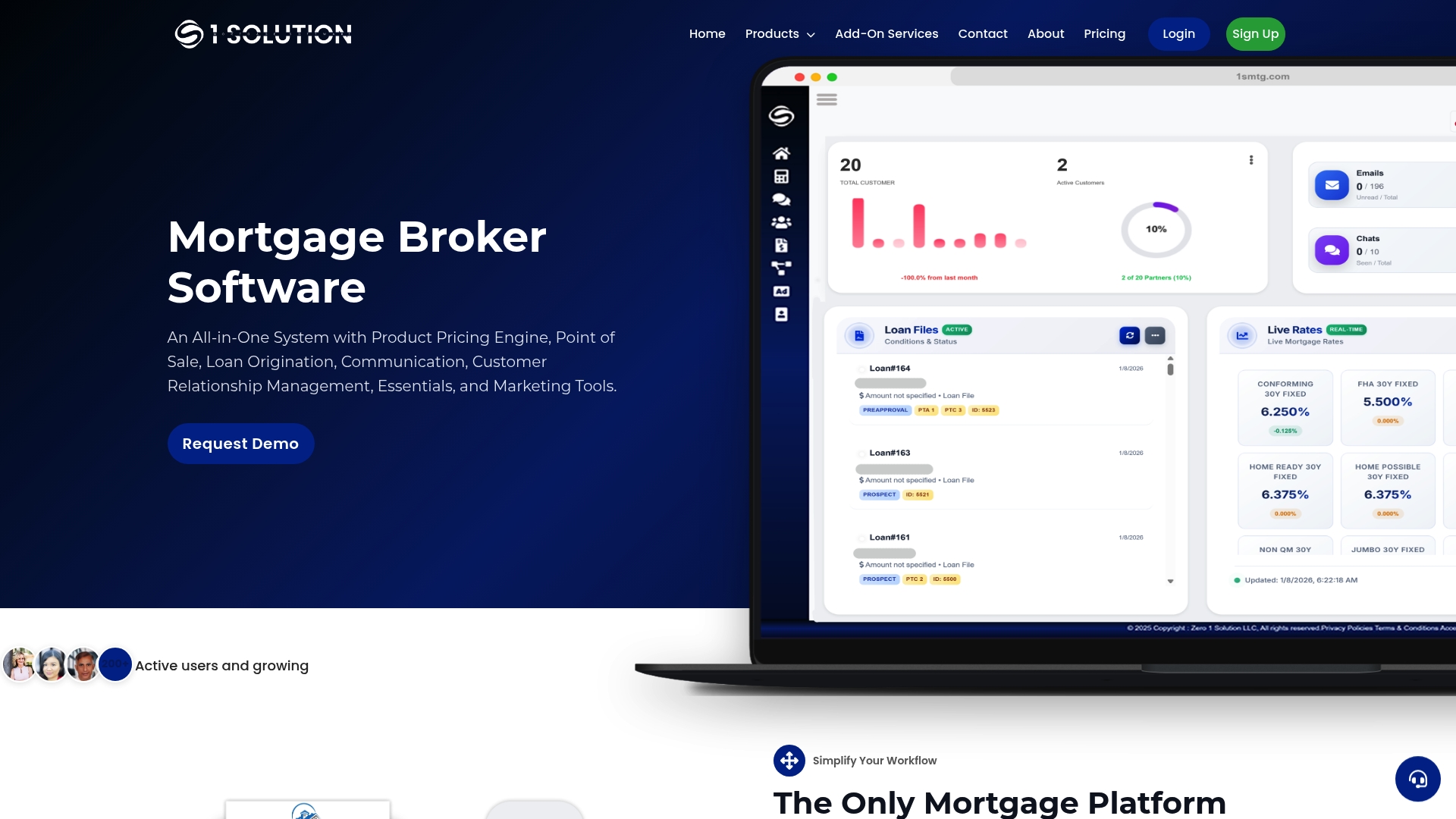
That means borrower data entered once at application flows through underwriting, pricing, and closing without a single re-key, and your compliance lead gets time-stamped, immutable records without stitching together exports from five vendors. For a brokerage still reconciling spreadsheets between systems, this is the fastest way to a working master record without a year-long integration project.
If you want to see how a pilot scope would look on your own loan volume, book a demo of 1 Solution Mortgage Software and walk through your current system stack with the team.
Sources
For deeper background, see MuleSoft's SSOT explainer, Profisee's enterprise implementation guide, and ZENRG Finance's take on centralized borrower relationships.
- Introducing A Real Automated Solution That Ensures “Source of Truth” Processes – PROGRESS in Lending
- MortgageExchange® | Post-Close LOS to Core & Servicing Automation for Credit Unions
- A Single Source of Truth: Why Institutions Need Aligned Loan Analytics