
An accurate mortgage preapproval amount gives you a realistic buying range and a stronger offer. Full stop. When your preapproval reflects verified income, documented assets, and a hard credit check, sellers and their agents take it seriously. Two caveats matter from the start: first, mortgage applications are sometimes denied at underwriting even after a formal preapproval, usually because the initial figures were based on incomplete assumptions; second, the CFPB is direct that what matters is whether your lender has actually documented and reviewed your income and assets, not just what the letter is labeled.
For your home search, that means shopping within a verified price range and asking your lender to run a payment estimate on each specific property before you write an offer. The purchase price on your letter is a ceiling, not a guarantee that any particular house fits your budget.
Take these steps now:
- Get a document-verified preapproval with a hard credit pull, not a prequalification estimate.
- Ask your lender to run a property-specific payment for any home you are seriously considering.
- Set a personal comfort cap below the lender's maximum before you start touring.
- Keep your financial picture stable: no new debt, no large cash moves, until closing.
Table of Contents
- Prequalification vs. preapproval: why the difference changes everything
- What actually determines how accurate your preapproval amount is
- The concrete benefits of having an accurate preapproval
- How to get a reliable preapproval before you start making offers
- Your preapproval is higher than you're comfortable with — here's what to do
- What a preapproval does not guarantee
- How long preapprovals last and when you need to refresh yours
- Practitioner tips from mortgage operations and underwriting
- Key Takeaways
- The part most buyers get wrong about preapprovals
- Sources and further reading
Prequalification vs. preapproval: why the difference changes everything
These two terms get used interchangeably, and that confusion costs buyers. Prequalification is an estimate based on self-reported income and debt figures, with no document review and usually only a soft credit check. Preapproval is a conditional commitment built on verified documents and a hard credit pull. The lender reviews income, assets, debt, and credit before issuing the letter, which is why it carries real weight at offer time.
During preapproval, a lender typically collects W-2s, recent pay stubs, two years of tax returns, bank statements, and asset account statements. That documentation is what separates a verified number from a guess.

Sellers and listing agents read preapproval letters looking for exactly that verification. A letter that names the lender, includes a contact number, and uses language like "verified income and assets" signals that a real underwriting review happened. In competitive markets, a verified preapproval letter often acts as a tiebreaker among similar offers.
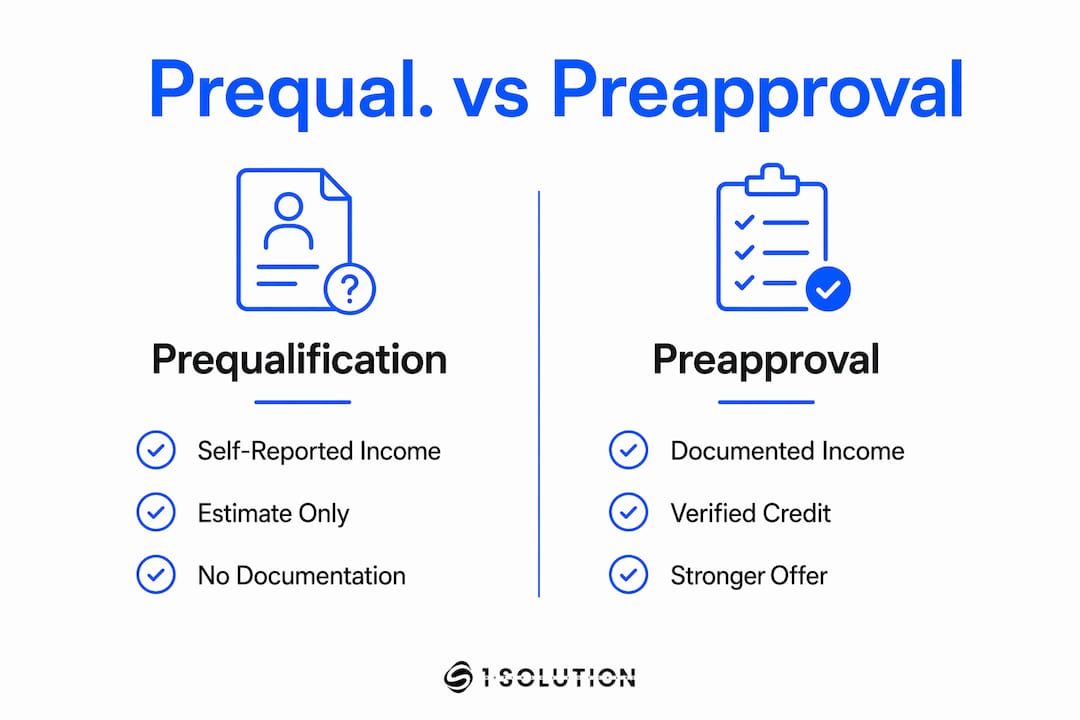
Here is what the gap looks like in practice: a buyer gets prequalified for a certain amount based on stated income, then goes through full document verification and finds the actual approved amount is significantly lower, commonly seen as about one-fifth less. One industry analysis found a 20% gap between prequalification estimates and verified preapproval amounts in illustrative scenarios.
| Feature | Prequalification | Preapproval |
|---|---|---|
| Income verification | Self-reported | Documented (W-2s, pay stubs, tax returns) |
| Asset verification | Self-reported | Bank and asset statements reviewed |
| Credit check | Soft pull (no score impact) | Hard pull (minor, temporary score impact) |
| Seller confidence | Low | High |
| Accuracy of amount | Estimate only | Conditional, verified figure |
What actually determines how accurate your preapproval amount is
A preapproval ceiling is built from a maximum monthly payment your lender calculates you can carry. The inputs on the lender's side are fixed and documented. The property-side variables are estimated, and that is where accuracy breaks down.
Lender-side underwriting inputs:
- Gross income: Your total pre-tax earnings from all documented sources.
- Debt-to-income ratio (DTI): Total monthly debt payments divided by gross monthly income. Most conventional loans require a debt-to-income ratio at or below typical regulatory thresholds.
- Credit score: Determines loan program eligibility and the interest rate used in the payment calculation.
- Verified assets: Down payment funds and reserves, confirmed through bank statements.
- Reserves: Months of mortgage payments you can cover after closing, often required for certain loan types.
Property-side variables the lender estimates:
Property taxes, homeowners insurance, HOA dues, and private mortgage insurance (PMI) all vary by address. A lender issuing a blanket preapproval letter uses placeholder estimates for these costs. The actual figures for a specific home can shift the monthly payment significantly. One analysis found that monthly payment differences can be substantial between similarly priced homes once real taxes, insurance, and HOA dues are applied.
Quick glossary:
- DTI (debt-to-income ratio): Monthly debts divided by gross monthly income, expressed as a percentage.
- PMI (private mortgage insurance): Required on conventional loans when the down payment is below 20%; adds to the monthly payment.
- Loan-to-value (LTV): Loan amount divided by the appraised property value; affects PMI requirements and rate.
- Reserves: Post-closing savings expressed in months of mortgage payments.
The practical takeaway: your preapproval letter tells you the maximum monthly payment you qualify for. Only a property-specific payment calculation using actual taxes, insurance, and HOA dues tells you whether a specific house fits within that limit.
The concrete benefits of having an accurate preapproval
Accuracy in your preapproval is not just a paperwork detail. It changes what you can do at the offer table and how efficiently you search.
- Stronger, more credible offers. A verified preapproval letter signals to sellers that your financing is real, not aspirational. In a multiple-offer situation, that credibility can be the deciding factor.
- A realistic search range. Knowing your verified ceiling keeps you from falling in love with homes you cannot actually close on, saving weeks of wasted effort.
- Earlier discovery of credit or documentation issues. The hard credit pull and document review surface problems before you are under contract, when you still have time to fix them.
- Faster closing timeline. Much of the underwriting work is already done. When you find the right home, the process moves faster because your file is not starting from scratch.
The risk of a weak preapproval is measurable. Approximately 8% of mortgage applications are denied at underwriting even after a formal preapproval, usually because the initial figures were based on incomplete assumptions. A verified preapproval built on real documents cuts that risk substantially.
Listing agents also know what to look for. They check whether the letter names a real lender with a contact number, whether it references verified income and assets, and whether the amount is plausible for the offer price. A vague or unverified letter raises flags, even when the buyer is genuinely qualified.
How to get a reliable preapproval before you start making offers
The quality of your preapproval depends almost entirely on what you bring to the lender and what questions you ask. Here is a step-by-step process that mortgage operations professionals use.
- Gather your full document package before you apply. Collect two years of W-2s, two years of federal tax returns, 30 days of pay stubs, two to three months of bank statements, and statements for any investment or retirement accounts you plan to use.
- Request a hard credit pull. A soft pull gives you an estimate; a hard pull gives the lender your actual qualifying score and surfaces any issues that need to be resolved.
- Ask whether an underwriter or pre-underwrite review is available. Some lenders offer a credit approval or underwriter-reviewed preapproval that carries more weight than a loan officer's conditional letter.
- Confirm the expiration date. Most preapprovals have a limited validity period before requiring refresh. Know yours before you start touring.
- Ask for a property-specific payment run on any home you plan to offer on. Give your lender the address and ask them to calculate the full monthly payment using actual property tax and HOA data for that address. This is the step most buyers skip, and it is where surprises hide.
- Verify the six numbers that prevent payment shock: the note rate (locked or floating), total monthly payment, property taxes, homeowners insurance, PMI if applicable, and cash to close.
Pro Tip: Ask your lender specifically: "Can you run the payment on this address using the actual tax and HOA figures?" If they say they cannot do that before an offer is accepted, ask why. A lender who runs property-specific numbers before you commit is a lender who is protecting you.
For buyers navigating digital mortgage applications, electronic document verification has shortened the preapproval timeline considerably. Uploading documents through a secure portal and getting a verified letter within 24–48 hours is now standard at many lenders.
Your preapproval is higher than you're comfortable with — here's what to do
Lenders calculate your maximum borrowing capacity using gross income and standard debt ratios. They do not factor in your retirement contributions, childcare costs, car maintenance, or the emergency fund you want to keep intact. That is by design: underwriting uses regulatory rules, not personal cash flow.
The result is that your preapproval ceiling often exceeds what you actually want to spend. Here is how to translate the lender's maximum into a number that works for your life.
- Set a personal comfort cap. Subtract 10–20% from your preapproval ceiling and treat that as your real search limit. If you are approved for $500,000, shop at $400,000–$450,000 unless you have a specific reason to push higher.
- Run a monthly cash-flow exercise. Take your net (after-tax) monthly income and subtract your current fixed expenses, savings goals, and a buffer for irregular costs. What is left is the maximum mortgage payment you can carry without stress.
- Use a mortgage calculator to model the full payment. A mortgage calculator that includes taxes, insurance, HOA, and PMI gives you a realistic monthly number, not just principal and interest.
- Consider down payment adjustments. Putting more down lowers the loan amount, eliminates or reduces PMI, and drops the monthly payment. Even an additional 5% down can make a meaningful difference.
Short example: Approved for a $480,000 purchase price at 6.75% on a 30-year loan, principal and interest runs roughly $3,113 per month. Add estimated property taxes of $600, homeowners insurance of $150, and HOA of $200, and the real monthly cost is closer to $4,063. That is the number to test against your take-home pay, not the principal-and-interest figure alone.
For a deeper look at comparing loan structures and payment scenarios, the mortgage deal comparison guide walks through how different loan types affect your monthly commitment.
What a preapproval does not guarantee
A preapproval is a conditional commitment, not a done deal. Buyers who treat it as a guarantee run into the most painful surprises.
Common misconceptions:
- Preapproval is not final loan approval. The loan still goes through full underwriting after you are under contract. The property must appraise at or above the purchase price, title must come back clean, and your financial picture must remain stable.
- A blanket purchase-price letter is not a payment approval. The letter says you qualify up to a dollar amount using estimated costs. It does not confirm that a specific house at that price fits within your approved monthly payment once real taxes and HOA are applied.
- A floating rate is not a locked rate. If your preapproval used a rate assumption and rates have moved since, your qualifying payment has changed.
Red flags on a preapproval letter:
- Vague language like "based on information provided" with no mention of document verification.
- No lender name, NMLS number, or direct contact for the loan officer.
- No expiration date.
- Placeholder language for taxes and insurance ("estimated" with no figures).
What can void your preapproval outcome before closing: taking on new debt (a car loan, a new credit card), a large unexplained cash deposit, a job change, or a significant rate increase that pushes your DTI above the qualifying threshold. Any of these can trigger a re-underwrite that changes the outcome.
How long preapprovals last and when you need to refresh yours
Most preapprovals have a limited validity period before requiring refresh. Lenders set expirations because documents go stale: a pay stub from four months ago no longer reflects your current income, and your credit file may have changed.
Triggers that should prompt a refresh:
- Your income changes (new job, raise, loss of income, or a switch from salaried to self-employed).
- You take on new debt or close existing accounts.
- Your home search extends beyond the expiration date.
- Interest rates have moved enough to affect your qualifying payment or loan program.
- A seller or listing agent requests an updated letter dated within the last 30 days.
Action items for staying current:
- Mark your expiration date on your calendar and set a reminder two weeks before it lapses.
- When you refresh, provide updated pay stubs and bank statements; the lender will re-pull credit.
- Ask your loan officer to note the refresh date on the new letter so agents can see it is current.
- If your search is running long, check in with your lender every 60 days even if the letter has not expired, especially when rates are moving.
For a full walkthrough of what happens at each stage of the mortgage approval process, including what underwriters evaluate and when, that resource covers the documentation and review steps in detail.
Practitioner tips from mortgage operations and underwriting
The buyers who avoid payment surprises are almost always the ones who asked better questions upfront. Here is what experienced brokers and underwriters recommend.
- Request a property-specific payment before you offer. Give your lender the address. Ask them to pull actual property tax data and HOA dues and run the full monthly payment. This single step catches most post-offer financing failures.
- Ask whether an underwriter-level review is available. A credit approval or underwriter-reviewed preapproval carries more weight with listing agents and reduces the chance of a late-stage denial.
- Document your down payment and reserve sources clearly. Large deposits need paper trails. If gift funds are involved, get the gift letter ready before you apply. Unexplained deposits slow underwriting.
- Verify whether your rate is locked or floating. A preapproval built on a rate assumption from 60 days ago may no longer reflect your actual qualifying payment if rates have shifted.
"Verification language and lender contact information on a preapproval letter are the first things a listing agent checks. A letter that names the loan officer, includes an NMLS number, and references documented income and assets tells the seller's side that this buyer's financing is real. A generic letter with no contact details raises doubt, even when the buyer is fully qualified." — Industry guidance from mortgage operations practitioners
The first-time buyer preapproval guide covers how precise preapproval figures translate into competitive positioning in active markets, which is worth reviewing before your first offer.
Omar Khamisa and the team at 1 Solution Mortgage Software built the platform from 20-plus years of hands-on mortgage operations experience, working as processors, underwriters, and loan originators. The tools reflect what practitioners actually need to support accurate preapproval workflows, not what looks good in a boardroom presentation.
Key Takeaways
An accurate, document-verified preapproval gives homebuyers a competitive edge at the offer table and prevents the payment surprises that derail closings.
| Point | Details |
|---|---|
| Verification over labels | What matters is whether income and assets were documented and reviewed, not what the letter is called. |
| Property-specific payments | Ask your lender to run the full payment on each target address; taxes and HOA alone can shift costs by $727 per month. |
| Personal comfort cap | Set your search limit 10–20% below the lender's ceiling; underwriting uses gross income, not your real cash flow. |
| Refresh before expiration | Most preapprovals last 30 days; refresh after any income change, new debt, or extended search. |
| Seller credibility | A verified letter with lender contact details and documented income language often acts as a tiebreaker in competitive offers. |
The part most buyers get wrong about preapprovals
Most buyers treat a preapproval as a shopping license. Get the letter, find a house, make an offer. The number on the letter becomes the budget. That framing is exactly backwards.
A preapproval is a ceiling, not a recommendation. The lender's job is to calculate the maximum you can borrow under regulatory guidelines. Your job is to decide how much of that ceiling you actually want to use, based on your real monthly cash flow, your savings goals, and the life you are building. Those are two different calculations, and conflating them is where payment shock comes from.
The other thing buyers underestimate is how much the specific property matters. Two homes at the same purchase price in different zip codes can carry monthly payments that differ by hundreds of dollars once real taxes, insurance, and HOA dues are applied. A preapproval letter that does not account for those variables is not giving you the full picture. Asking your lender to run a property-specific payment before you write an offer is not extra work. It is the work.
At 1 Solution Mortgage Software, we built our platform because we saw these gaps from the inside, from the processor's desk, the underwriter's chair, and the loan originator's pipeline. Accurate preapproval is not just about winning offers. It is about protecting buyers from commitments they cannot sustain. That is the standard we hold ourselves to, and it is the standard you should expect from any lender or broker you work with.
Sources and further reading
- CFPB: Prequalification vs. Preapproval — Regulatory clarity on what verification actually means and why the label matters less than the process.
- Bank of America: Mortgage Prequalification vs. Preapproval — Lender-side explanation of document requirements and typical validity periods.
- PNC Insights: Why Agents Should Prioritize Buyer Pre-Approval Letters — Practitioner perspective on how listing agents evaluate preapproval letters in competitive markets.
- American Hero Home Loans: Can You Trust Your Mortgage Preapproval? — Detailed breakdown of property-specific payment variability and the $727/month example.
- American Default: Prequalification vs. Preapproval — Industry glossary data on the 8% denial gap and the 20% prequalification-to-preapproval discrepancy.
- 1 Solution Mortgage Software Blog — Internal resource on the full mortgage approval process, documentation, and underwriting steps.
Before writing any offer, ask your lender to run the full monthly payment on the specific property address using actual tax and HOA figures. That one step is worth more than any amount of research.