
UDAAP in mortgage marketing comes down to one question: would a reasonable borrower walk away from your ad, text or call script with a false picture of the loan? If so, you have a problem, however good the fine print is. The brokers who stay out of trouble treat every marketing message, from a rate flyer to a text blast, as a record that must be reviewed, approved and kept. We built 1 Solution so that approval, consent, calling and record-keeping live in one system instead of five.
This guide covers what UDAAP means, which mortgage claims create risk, how Do Not Call (DNC) and Telephone Consumer Protection Act (TCPA) rules sit alongside it, and a review routine you can run this week.
TL;DR
- UDAAP means unfair, deceptive or abusive acts or practices. It applies to any provider of consumer financial products, including brokers, and to their marketing.
- Mortgage ads also face specific rules: Regulation N and Regulation Z ban particular misstatements such as calling a variable rate "fixed" or implying government endorsement.
- Regulation N requires you to keep materially different ads, scripts and training materials for 24 months.
- DNC and TCPA rules govern who you may call or text, when, and with what consent. Opt-outs must be honored within 10 business days.
- In 2025 the CFPB withdrew some UDAAP guidance, but the statute itself is still law.
Table of Contents
- What UDAAP means for a mortgage broker
- What changed in 2025, and what still applies
- Claims that create risk in mortgage ads
- A review routine for ads and scripts
- Do Not Call rules for mortgage outreach
- TCPA consent for calls and texts
- Why one platform makes this easier
- Perspective
- See it in your own workflow
- FAQ
- Sources
What UDAAP means for a mortgage broker
UDAAP stands for unfair, deceptive, or abusive acts or practices. Section 1036 of the Dodd-Frank Act makes it unlawful for a provider of consumer financial products or a service provider to engage in any of the three in connection with a consumer transaction. The CFPB's UDAAP examination procedures lay out how examiners apply each standard, and marketing is squarely inside them.
In plain terms:
- Deceptive: a representation or omission that misleads or is likely to mislead the consumer, where the consumer's reading is reasonable and the point is material (it would affect their decision). Fine print may not cure a misleading headline.
- Unfair: conduct that causes substantial harm consumers cannot reasonably avoid and that is not outweighed by benefits.
- Abusive: conduct that materially interferes with a consumer's ability to understand a term, or takes unreasonable advantage of their lack of understanding or their reliance on you to act in their interest.
The Mortgage Acts and Practices (MAP) rule, which the Mortgage Bankers Association describes as a rule where the FTC and CFPB share authority, adds mortgage-specific advertising limits. It is now codified as Regulation N.
What changed in 2025, and what still applies
The CFPB's Spring 2026 Semi-Annual Report states that on May 12, 2025 the Bureau withdrew UDAAP guidance, including the 2023 policy statement on abusive acts, and that it terminated the Navy Federal consent order on July 1, 2025. That changes how the Bureau may enforce, not what the statute says. Regulation N, Regulation Z advertising rules and the TCPA are untouched by those withdrawals, and state regulators and attorneys general can also act on unfair and deceptive practices. Build your program on the rules, not on the current enforcement mood.

Claims that create risk in mortgage ads
Regulation N, 12 CFR 1014.3 lists prohibited misrepresentations in mortgage advertising. The list covers interest rates, APR, fees, taxes and insurance, prepayment penalties, product type, minimum payments, government affiliation, the source of the communication, and preapproval or guarantee claims. The ones brokers trip over most:
| Claim | Why it is risky | Safer approach |
|---|---|---|
| "Fixed" on an adjustable loan | Regulation Z requires "ARM" language before the first use of "fixed" and a statement of the fixed period and that the rate may rise | Name the product type first, state the fixed period next to the word |
| Teaser rates with no context | Material limits, such as when an introductory period ends, must be clearly disclosed | Put the reset and conditions in the same view as the rate |
| "Pre-approved" in a mass mailer | Preapproval claims are restricted; ads suggesting approval before the usual steps drew a CFPB warning | Use "prequalification" only if that is what the process is |
| Look-alike government branding | Ads may not call a product a government program unless it is FHA, VA or similar | Name the actual program and your own company prominently |
| Using the borrower's current lender's name | Allowed only with equally prominent disclosure of who is advertising and that you are not associated with that lender | Lead with your own name |
| Promising to eliminate debt | Claims that a loan will erase or forgive existing obligations are prohibited | Describe what the loan does in payment and rate terms |
The CFPB's procedures cite a 2004 FTC case against a mortgage broker that advertised a "3.5% fixed payment 30-year loan" while offering adjustable loans with minimum payments that caused negative amortization. The point for your shop: the headline is judged by what a consumer would reasonably believe, not by what the disclosure page says.
A review routine for ads and scripts
The CFPB's mortgage origination examination procedures tell you what examiners look for. Turn them into a routine:
- Inventory every channel. Website, social posts, email, texts, call scripts, flyers, co-marketing with agents and lead-vendor copy. Anything a loan officer sends counts.
- Check the headline against the whole offer. Teaser rates, introductory periods, rate resets, discount prerequisites, balloon payments and prepayment penalties must be clearly disclosed, not buried.
- Make disclosures readable. Examiners expect marketing to be comprehensible to the target audience.
- Avoid implied fiduciary language. Do not suggest you act as the borrower's best-interest adviser unless that is true.
- Be upfront on cross-sold products and compensation. Costs of add-on products and how the salesperson is paid should be explained clearly and on time.
- Approve before publishing. One named reviewer, one dated sign-off.
- Keep the record. Regulation N requires copies of all materially different commercial communications, sales scripts, training and marketing materials and product descriptions for 24 months from the last date they were used. It also bars asking a consumer to waive the rule's protections.
The routine fails in the same place at most shops: loan officers who build their own graphics and texts outside any approval flow. Our guides on RESPA marketing compliance and a compliance setup checklist go deeper on closing that gap.
Do Not Call rules for mortgage outreach
Under 47 CFR Part 64, Subpart L, you may not make a telephone solicitation to a residential subscriber before 8 a.m. or after 9 p.m. local time, or to a number on the national Do Not Call registry. Key operating points from the rule:
- Safe harbor for a mistaken call requires written procedures, trained staff, a recorded suppression list, and a registry version no more than 31 days old.
- Exceptions include prior express written permission (a signed agreement) and a personal relationship.
- Internal list: keep a written policy and your own do-not-call list, honor requests within 30 days, keep them for five years, and identify the caller and the company on whose behalf the call is made.
A do-not-call request applies to the entity on whose behalf the call is made and to affiliates the consumer would reasonably expect to be covered, as the FDIC's compliance manual explains. If you buy leads or share a brand with affiliated companies, that matters.
TCPA consent for calls and texts
The TCPA sets consent rules on top of DNC. Per the MBA's 2026 servicing briefing, calls or texts to cell phones using an autodialer or an artificial or prerecorded voice need prior express written consent when they are advertising or telemarketing, and prior express consent otherwise. Prerecorded or artificial-voice messages to residential lines also need prior express written consent, with narrow exceptions listed in the rule text.

Handling opt-outs
The FCC's revocation rule took effect April 11, 2025, per the same briefing:
- Consumers may revoke consent in any reasonable manner, and you cannot require one exclusive method.
- You must honor the request within a reasonable time, no more than 10 business days.
- You may send one confirmation text that only confirms the opt-out. If sent within five minutes, it is treated as within the original consent.
A separate FCC rule on one-to-one consent for prerecorded telemarketing was slated for January 27, 2025 and drew an Eleventh Circuit challenge. Check the FCC's site for its current status before you rely on shared-consent lead forms.
The practical difficulty is that a borrower may say "stop" in a text reply, on a call, in an email or to a processor. If those channels live in different tools, no one sees the request. Our posts on mortgage texting compliance, eConsent capture and call recording rules cover the details.
Why one platform makes this easier
UDAAP, DNC and TCPA are three rule sets with one shared weakness: they punish gaps between systems. The ad that was approved but never saved. The opt-out sent by text but still on the email drip. The script updated in a document but not in the dialer. Each fix is simple. Keeping them all in sync across a CRM, a texting tool, a phone system and a website is the hard part.
That is why we put CRM, communication, compliance, marketing and borrower portal tools in one connected platform. When email, SMS, chat, voice and video run through the same system as the loan file and the contact record, your consent history and your marketing record sit next to the borrower, not in someone's inbox. For more on structuring this, see our guides on compliance reporting and secure borrower messaging.
Perspective
After more than 20 years as a processor, underwriter, loan originator and systems consultant, I have seen the same pattern: compliance fails at the seams between tools, not in the policy manual. A broker pays for a CRM, a texting app, a phone system, a website and a signature tool, and nobody owns the question of what a borrower was told, when, and whether they ever said stop.
We built 1 Solution as a self-funded, independent platform for brokers, not banks, because brokers deserve control over their own marketing record. Pricing, CRM, communication, POS, LOS, compliance and marketing in one place means your team works from one set of contacts, one set of messages and one trail. Our usage fees are published: phone, text and fax are $0.10 per minute or message.
UDAAP is a judgment about what your customer reasonably understood. The best protection is a process that makes the careful version the easy version.
Omar Khamisa
See it in your own workflow
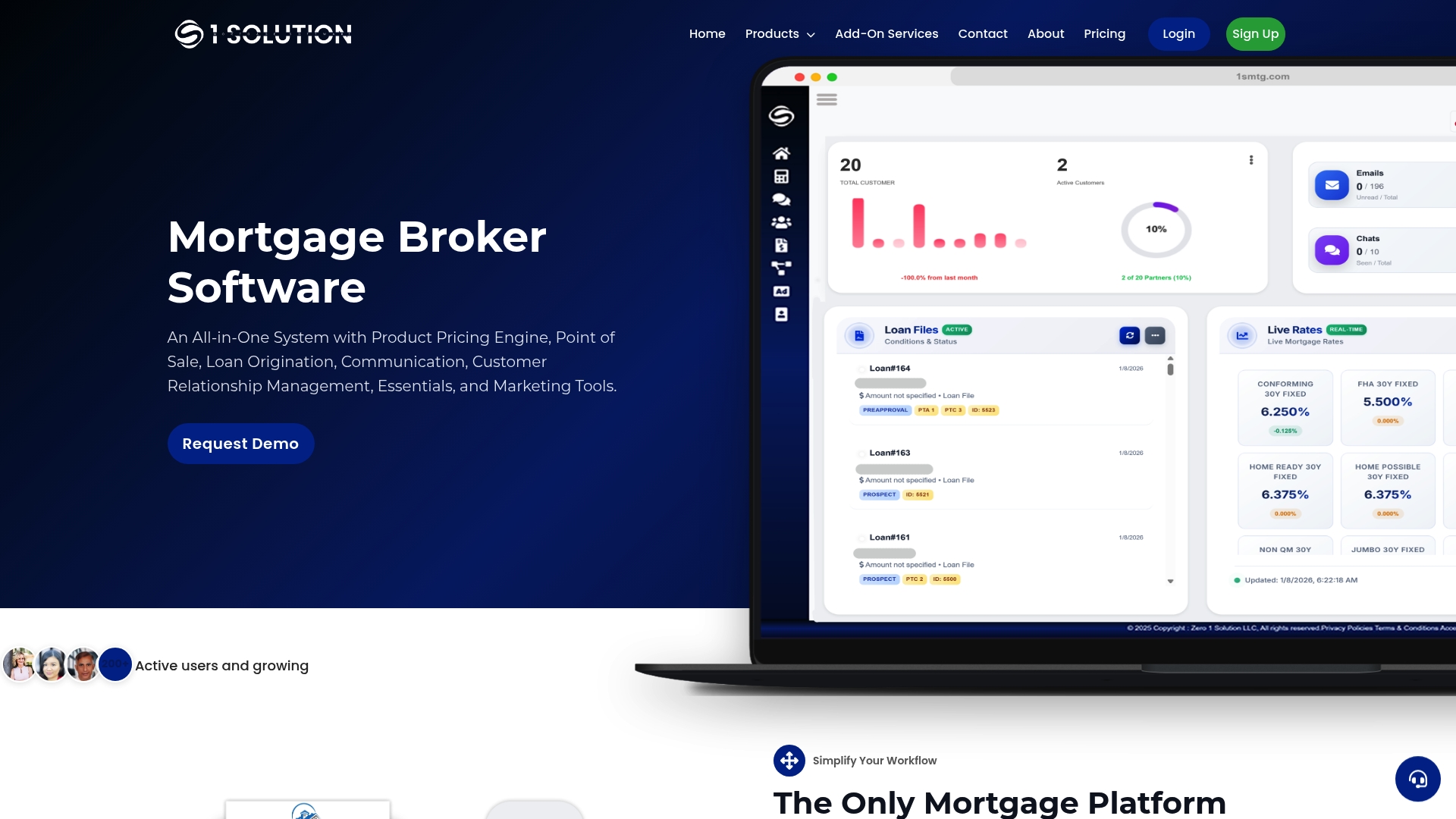
If your team is juggling separate tools for CRM, texting, calling and your website, we can show you how 1 Solution brings them together with personalized onboarding and real human support. Our platform includes a CRM, borrower POS portal, e-signature, marketing automation and communication tools, with optional add-ons such as a mortgage website and branded email setup. Start at 1smtg.com.
FAQ
Does UDAAP apply to mortgage brokers, or only to lenders?
It applies to any provider of consumer financial products or services and to service providers, which includes brokers. Mortgage advertising is also covered by Regulation N and Regulation Z advertising rules.
Can a good disclosure fix a misleading headline?
Not reliably. The CFPB's procedures say written or fine-print disclosures may be insufficient to cure a misleading headline, so the headline itself must give an accurate impression.
How long do we keep ads and scripts?
Regulation N requires copies of materially different commercial communications, sales scripts, training and marketing materials and product descriptions for 24 months from the last date they were used.
How fast must we honor a text opt-out?
Within a reasonable time not exceeding 10 business days under the FCC's revocation rule, effective April 11, 2025. Consumers can revoke by any reasonable means, so capture requests from every channel.
Sources
- CFPB UDAAP examination procedures
- MBA UDAP, UDAAP and MAP Rule course
- CFPB Spring 2026 Semi-Annual Report
- 12 CFR 1014.3, eCFR
- 12 CFR Part 1014, eCFR
- Regulation Z, section 1026.24 Advertising
- CFPB 2012 warning on misleading mortgage ads
- CFPB mortgage origination examination procedures
- 47 CFR Part 64 Subpart L, eCFR
- FDIC TCPA examination manual
- MBA Navigating Borrower Engagement, 2026
- NCLC, new consumer law rights taking effect in 2025