
Miscommunication is the primary operational cause of avoidable mortgage closing delays because it converts small data or timing errors into multi-day stalls that no one party can resolve alone. Submit-to-close pull-through has declined from historical benchmarks near two-thirds to roughly half, meaning nearly half of submitted loans now stall before funding — and the majority of those stalls trace back to gaps between parties, not to borrower qualification.
- Root causes: inter-party information gaps, missed contract changes, late or incorrect documents, wiring errors, appraisal timing mismatches, and new borrower credit activity.
- Immediate triage step: the moment you sense a delay, lock one point of contact per party and confirm every critical fact in writing within the hour.
- Next step: run the pre-closing audit checklist in Section 5 and escalate using the triage flow in Section 9.
Key Takeaways
Miscommunication delays closings because small data and timing errors compound across pipeline stages when no single party owns the full picture — and the fix is explicit protocols, not harder work.
| Point | Details |
|---|---|
| Pull-through is declining | Submit-to-close pull-through has dropped to roughly 53%, signaling that stalls between submission and funding are a systemic problem. |
| Front-end validation is the highest-leverage fix | Name-match verification, funding-source confirmation, and structured intake at origination reduce downstream condition volume materially. |
| SLAs and a pre-closing audit prevent most delays | A 4-business-hour document response window and a 48/24/4-hour pre-closing audit catch the majority of communication failures before closing day. |
| Technology must be paired with human follow-up | Automated alerts without a named human responsible for the response leave issues unresolved and raise borrower anxiety. |
| 1 Solution Mortgage Software | Connects LOS, CRM, POS, and communication tools in one platform to eliminate the inter-party gaps that cause most closing delays. |
Table of Contents
- Why miscommunication delays closings: the failure modes you'll see again and again
- How communication failures hit each pipeline stage differently
- Immediate steps to take when you sense a communication breakdown
- Repeatable prevention: checklists, SLAs, and protocols
- When to use a centralized platform vs. lightweight tools
- Scheduling, buffers, and role ownership rules
- Real-world scenarios and the fixes that actually worked
- If a closing is delayed: hour-by-hour triage
- The case for putting communication at the center of mortgage operations
- How 1 Solution Mortgage Software reduces the communication gaps that delay closings
- Sources
Why miscommunication delays closings: the failure modes you'll see again and again
Closing professionals consistently identify the same repeatable breakdowns — missed contract-change notices, late documents, and simple human errors that stop progress cold. Here are the modes that produce most delays:
- Inter-party information gaps: the lender, title company, and real estate agent each hold a piece of the picture and no one confirms the others have it. A condition gets cleared on the lender side but title never hears about it.
- Missed contract changes: a repair credit or closing-cost amendment gets signed by the buyer's agent and never forwarded to the loan officer. The CD is wrong on closing day.
- Late or missing documents: a borrower submits a bank statement three days after the underwriter's deadline. The file sits.
- Wiring and check errors: incorrect wire instructions or a late cashier's check push funding past the business-day cutoff, rolling the closing to the next morning.
- Appraisal and title timing: the appraisal is ordered a week late, or a title search surfaces a probate issue no one flagged at origination.
- New borrower credit activity: a borrower opens a credit card between application and closing. The underwriter catches it at the final review and the file goes back to conditions.
- Incorrect borrower data: a misspelled name on the loan application doesn't match the notarized closing documents, and the notary cannot proceed.
Every one of these is detectable before closing day. That's the point.
How communication failures hit each pipeline stage differently
The same communication fault lands differently depending on where it occurs. A data error at origination costs hours; the same error discovered at the closing table costs days.
- Origination: data capture errors — wrong name spelling, unverified funding source, undisclosed co-borrower — create a submit-first, resolve-later culture that shifts the discovery burden onto underwriters. Front-end validation at intake is the single highest-leverage fix.
- Processing: missing documents stall the file in queue. A processor who doesn't confirm receipt within 24 hours of a doc request creates invisible latency that compounds across the pipeline.
- Underwriting: unvalidated income, undisclosed credit changes, or a condition that wasn't communicated back to the broker generates a second or third round of conditions. Brokers report that lack of transparent underwriter outreach is a frequent cause of derailed deals — a proactive call from an underwriter prevents most of these.
- Appraisal: late ordering or a scheduling miscommunication between the AMC and the listing agent pushes the appraisal past the rate-lock window. Ordering within 48 hours of application and confirming access with the listing agent directly prevents this.
- Title: a title defect or probate issue discovered late in the process can add weeks. Early title commitment review — not just at closing — catches these.
- Closing and funding: last-minute condition failures, incorrect wire instructions, or a borrower who arrives without the right ID or funds format can push funding past the cutoff. Measuring latency between stages rather than only tracking outputs helps teams surface these stalls before they hit the closing table.
Immediate steps to take when you sense a communication breakdown
Speed matters. The first hour after you detect a problem determines whether you lose a day or a week.
- Confirm the facts in writing. Call the relevant party, then follow up with a text or email summary of what was confirmed. Verbal-only is not confirmation.
- Lock one point of contact per party. Assign a single name for the lender, title company, real estate agent, and borrower. All communication routes through those four people.
- Verify wire instructions directly. Call the title company using a number from your verified contact list — never from an email. Wire fraud starts with a spoofed instruction.
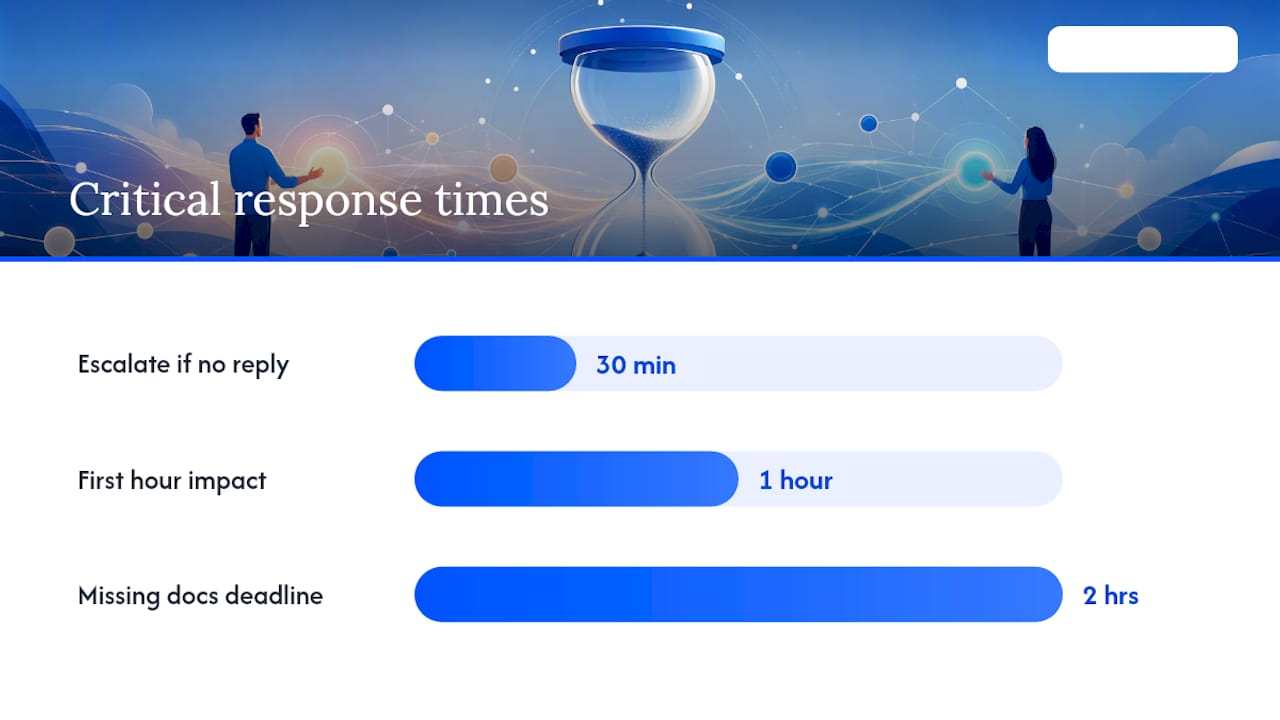
- Request any missing document with a hard 2-hour turnaround. State the deadline explicitly: "We need this by 2:00 PM to fund today."
- Notify title and the agent simultaneously. Use one status channel — a group text or shared thread — so no one is working from different information.
- Confirm the borrower's funds format. Cashier's check or wire? Does the amount match the final CD? Confirm this the business day before closing, not the morning of.
- Escalate if no response within 30 minutes. Go up one level on both sides. Silence at this stage is not neutral — it is a delay accumulating.
Pro Tip: If the signer arrives without the correct ID or the wrong funds format, don't wait for a solution to appear. Have a backup wire option pre-arranged with title and know your lender's same-day funding cutoff time before closing day starts.
A short template for immediate outreach: "Hi [Name], we have a time-sensitive issue on [borrower name]'s file closing today. [State the specific problem in one sentence.] We need [specific item] by [time]. Please confirm receipt of this message."
Repeatable prevention: checklists, SLAs, and protocols
Reactive fixes are expensive. These protocols stop most miscommunication before it starts.
Core protocols to implement now:
- Maintain a single shared status board visible to the loan officer, processor, and title contact for every at-risk file.
- Run a pre-closing audit at 48 hours, 24 hours, and 4 hours before closing (see checklist below).
- Enforce a borrower document freeze window: no new documents accepted within 72 hours of closing without a supervisor sign-off.
- Standardize gift-fund handling with a written checklist: gift letter, donor bank statement, transfer confirmation.
- Verify name spelling against government-issued ID at origination — not at the closing table.
- Schedule a daily 10-minute sync between the loan officer, processor, and title agent for any file closing within 5 business days.
Sample SLA values:
- Critical document requests: 4-business-hour response window.
- Underwriter outreach on exceptions: within 24 hours of condition issuance.
- Pre-closing confirmation call with borrower: 24 hours before closing.
- Wire instruction verification: confirmed by phone no later than 4 hours before funding cutoff.
Pre-closing audit checklist (run at 48, 24, and 4 hours out):
- Final CD issued and acknowledged by borrower.
- All conditions cleared and documented in the file.
- Wire instructions verified by phone with title.
- Borrower confirmed on funds format and arrival time.
- Name on all documents matches government-issued ID.
- Title commitment reviewed for open liens or exceptions.
- Appraisal in file and value confirmed with underwriter.
A mortgage communication audit run weekly across your pipeline catches latency before it becomes a delay.
When to use a centralized platform vs. lightweight tools
The right answer depends on volume and team structure.
- Under 30 loans per month: a disciplined shared status board (a pinned group thread or a simple spreadsheet updated daily), paired with the SLAs above, handles most communication risk. The protocols matter more than the tool.
- Over 30 loans per month or multi-office: manual coordination breaks down. You need an integrated platform with event-driven alerts, document tracking with timestamps, role-based access, and automated pre-closing triggers.
Features that materially reduce miscommunication:
- Single-source status board updated in real time.
- Event-driven alerts when a document is uploaded, a condition is cleared, or a deadline passes.
- Audit trail for every contract change and condition update.
- Secure wire instruction delivery — never via unencrypted email.
- Automated pre-closing triggers that fire the audit checklist at 48 and 24 hours.
Closing coordination systems built for mortgage teams handle inter-party handoffs in ways that generic project tools cannot.
The critical caveat: technology does not replace human judgment. As Sean Durocher notes, automation without manual follow-up leaves issues unresolved and raises borrower anxiety. An automated alert that no one acts on is just noise. Pair every system trigger with a named human responsible for the response.
Scheduling, buffers, and role ownership rules
Small scheduling decisions prevent big delays.
Do/don't checklist:
- Avoid Friday closings when possible — a funding issue on Friday becomes a Monday problem.
- Never schedule closing for after 2:00 PM if same-day funding is required.
- Build a 2-business-day buffer between your clear-to-close and the scheduled closing date.
- Set explicit arrival expectations with buyers: what time, what to bring, what format for funds.
Role ownership: who owns what, and who to call first
| Issue | Owner | First call |
|---|---|---|
| Missing borrower document | Processor | Loan officer if no response in 2 hours |
| Condition not cleared | Underwriter | Loan officer escalates to AE |
| Wire instruction discrepancy | Title agent | Loan officer confirms by phone immediately |
| Contract change not forwarded | Real estate agent | Loan officer requests written confirmation |
| Appraisal not received | AMC coordinator | Loan officer contacts AMC directly |
| Borrower no-show at closing | Closing agent | Loan officer contacts borrower and agent simultaneously |
For after-hours problems, every file should have a named escalation contact at the lender, title company, and real estate brokerage — with a cell number, not just an office line. See mortgage team structure guidance for how to map these roles across your brokerage.
Real-world scenarios and the fixes that actually worked
Misspelled name on closing documents. The borrower's middle name was entered incorrectly at origination. The notary flagged it at the table. Fix: the loan officer contacted the lender's closing department, a corrected package was issued within 3 hours, and closing was rescheduled for the next morning. Prevention: name-match verification against government ID at the point of application.

Late cashier's check. The borrower arrived with a personal check instead of a cashier's check. The title company could not accept it. Fix: the borrower drove to the bank, returned 90 minutes later, and closing proceeded the same day. Prevention: confirm funds format and amount in the pre-closing call 24 hours out.
Appraisal timing mismatch. The appraisal was ordered 10 days after application due to a miscommunication between the processor and the AMC. The rate lock expired before the appraisal was received. Fix: the lender extended the lock at cost. Prevention: appraisal ordering confirmed within 48 hours of application, with access confirmed directly with the listing agent.
Probate title issue. A title search revealed an unresolved probate matter on the seller's side that no one had flagged. Fix: the closing was delayed 3 weeks while the estate attorney resolved the issue. Prevention: early title commitment review at the processing stage, not just at closing.
Borrower opens new credit. A borrower opened a store credit card two weeks before closing. The underwriter caught it at final review and required a new credit report and updated DTI analysis. Fix: the file was re-underwritten and closed 4 days late. Prevention: explicit written instruction to the borrower at application and again at clear-to-close: no new credit, no large purchases, no job changes.
Last-minute repair credit. The buyer and seller agreed to a $3,000 repair credit after the final walkthrough. The agent didn't forward the amendment to the loan officer. The CD was wrong at closing. Fix: a corrected CD was issued and the 3-day waiting period was waived with borrower consent. Prevention: any contract change triggers an immediate notification to the loan officer — written, same day.
If a closing is delayed: hour-by-hour triage
First 1–2 hours:
- Identify the specific cause — document, wire, condition, or scheduling — and confirm it in writing.
- Notify all parties simultaneously: lender, title, real estate agent, and borrower.
- Assess whether same-day funding is still possible. Know your lender's cutoff time.
- If wiring is the issue, confirm instructions by phone and initiate the corrected wire immediately.
- If a document is missing, request it with a hard deadline and name the person responsible.
Next 4 hours:
- If same-day funding is not possible, confirm the reschedule date with all parties in writing.
- Arrange a cashier's check as a backup if wire timing is uncertain.
- Confirm the borrower's availability for the rescheduled date before communicating it to the seller's side.
- Document every action taken and every response received in the file.
24-hour plan:
- Issue a written status update to all parties with the confirmed new closing date and time.
- Re-run the pre-closing audit checklist for the rescheduled closing.
- Confirm that the cause of the original delay has been fully resolved — not just worked around.
Escalation template: "This is [Name] at [Company] regarding [Borrower Name]'s closing. We have a [specific issue] that is preventing funding today. We need [specific action] by [time] to proceed. Please confirm you've received this and can act on it."
Reschedule vs. proceed with contingency: proceed same-day only if the cause is resolved and funding can clear before the lender's cutoff. Reschedule if any party is unavailable, the cause is unresolved, or the funding window has passed. A clean reschedule is better than a failed funding attempt.
The case for putting communication at the center of mortgage operations
Loan officers and brokers spend years mastering guidelines, pricing, and compliance — and then lose deals to a misspelled name or a wire that went out an hour late. That gap between technical expertise and operational execution is where most avoidable delays live.
After more than 20 years working across mortgage operations as a processor, underwriter, loan originator, and systems consultant, the pattern is consistent: teams that build explicit communication protocols into their workflow — not as an afterthought, but as a core operating standard — close more files on time than teams that rely on individual heroics and last-minute calls.
The triage and prevention guidance in this article reflects what actually works in practice. Front-end validation at origination, named ownership for every handoff, and a pre-closing audit run at 48 and 24 hours eliminate the majority of communication-driven delays before they start. Loan officers who treat Nguyen Mai's approach — proactive, frequent outreach including preemptive underwriter calls — as a standard, not an exception, see fewer surprises at the closing table.
How 1 Solution Mortgage Software reduces the communication gaps that delay closings
Fragmented tools are where communication breaks down. When your LOS, CRM, and borrower portal don't talk to each other, critical updates fall through the cracks and your team spends time chasing status instead of closing files.
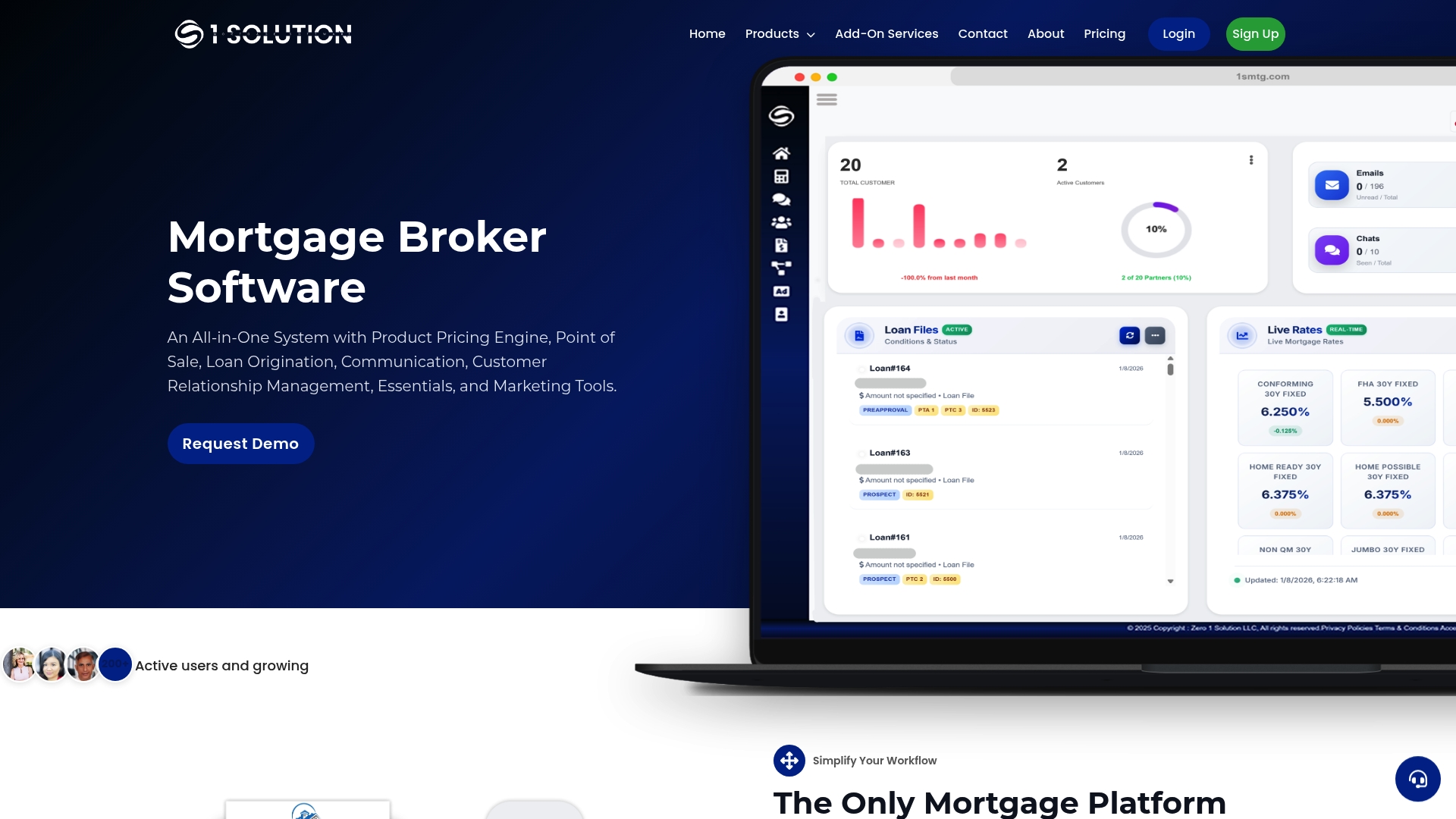
1 Solution Mortgage Software connects every stage of the loan process in one platform — built specifically for independent brokers and loan officers by people who've worked the pipeline from both sides. A single status board keeps every party aligned. Event-driven alerts fire when a document is uploaded or a condition clears. Secure wire instruction delivery eliminates the fraud risk of email-based instructions. The integrated POS, LOS, and CRM mean your borrower data, communication history, and file status live in one place, not three.
If recurring communication stalls are costing you closings, request a demo at 1smtg and see how the platform maps to the prevention protocols in this guide.
Sources
- Submit-to-close Decline Signals Mortgage Process Inefficiency
- Broker shares how poor lender communication can derail mortgage deals | Mortgage Professional
- Even perfect automated systems fail without communication, says industry expert | Mortgage Professional
- Closing delays are common
- Mortgage closings get delayed — common causes and how to avoid them
This article is general information, not a substitute for advice from a qualified financial advisor. Consult a qualified financial professional about your own circumstances before acting on anything here.