
Cloud mortgage software shortens cycle times, lowers cost per loan, and improves borrower conversion while strengthening compliance. Lenders that fully use Freddie Mac's Loan Product Advisor automated capabilities save an average of $1,700 per loan and cut cycle time by about five days. We built this guide from Omar Khamisa's two decades in mortgage operations, so the details and implementation steps below reflect what actually works on the ground.
TL;DR:
- Lenders that fully use Freddie Mac’s LPA automation save an average of $1,700 per loan and cut cycle time by about five days.
- Freddie Mac reports that mortgages originated with digital tools are four times less likely to have loan defects than those without them.
- Plan a phased rollout: map workflows for four to six weeks, pilot one branch or loan type for two to three months, then expand gradually.
- During a three to six month pilot, compare closing time, loan cost, pull through, and defect rates with a 30 to 60 day baseline.
- Ask vendors for MISMO aligned controls, encryption details, and recent penetration test reports before signing rather than accepting vague security assurances.
Table of Contents
- What are the main benefits of cloud mortgage software?
- How automation speeds up processing and cuts manual work
- Why borrower experience drives better conversion rates
- Compliance, security, and risk advantages worth understanding
- Core features and integrations your platform needs
- Planning a migration without the common pitfalls
- Which metrics prove the software is paying off
- What practitioners learn after years in mortgage operations
- Our honest take on moving to the cloud
- A broker-first cloud platform built from inside the industry
- FAQ
- Sources
What are the main benefits of cloud mortgage software?
Most brokers and lenders evaluating a platform switch want the short list before the long explanation. Here is what cloud mortgage software delivers, roughly in the order you will notice it:
- Faster cycle times: automated verifications and workflow routing cut days off origination, often the first gain a team sees.
- Lower cost per loan: fewer manual touches and less rework reduce the labor cost baked into every file.
- Fewer defects and errors: automated underwriting and data validation catch problems before they reach closing.
- Stronger compliance and audit trails: every action is logged, timestamped, and traceable.
- Better borrower conversion: mobile-friendly portals and status tracking keep applicants engaged instead of abandoning midway.
- Scalability: volume swings do not require proportional headcount increases.
- Centralized analytics: pipeline, pricing, and performance data live in one place instead of scattered spreadsheets.
Speed and cost savings tend to show up within the first few pilot cycles. Compliance strength and analytics maturity usually build over six to twelve months as teams adopt the tools fully.
How automation speeds up processing and cuts manual work
Automated income, asset, and employment verification removes a large share of the manual document chasing that slows traditional underwriting. Tools like Freddie Mac's LPA and AIM assess eligibility and verify data directly against source systems, so underwriters spend less time re-checking paperwork and more time on exceptions that actually need judgment.
Document automation adds another layer. Optical character recognition and classification sort incoming files automatically, pulling data into the loan file without a processor retyping it. Cloud-native suites like the TCS Digital Mortgage Suite support cognitive document digitization across hundreds of document types, which is what makes straight-through processing realistic at scale.
Workflow orchestration ties these pieces together, routing files automatically based on status and exceptions rather than relying on someone remembering to move a file forward.
- Higher straight-through processing rates mean fewer files stall waiting for a human touch.
- Fewer reworks follow naturally once data entry errors drop.
- Staff time shifts toward underwriting judgment and borrower communication instead of paperwork.
Freddie Mac reports that mortgages originated with digital tools are on average four times less likely to have loan defects, a direct result of this kind of automated verification replacing manual review (Freddie Mac).
Why borrower experience drives better conversion rates
A borrower portal with mobile forms, real-time status tracking, and guided checklists keeps applicants moving instead of guessing what happens next. Industry commentary consistently points to a transparent, digital-first experience as the factor that most directly drives conversion in a competitive market, often ahead of pricing alone.
Lengthy, confusing applications and slow responses push borrowers to abandon mid-process. A clean, mobile-first POS experience removes much of that friction by letting applicants upload documents from a phone and see exactly where their file stands. Our guide to digital mortgage application benefits covers this from the homebuyer's side.
- Status tracking cuts the "where is my loan" phone calls that eat loan officer time.
- CRM integration means a borrower's question routes to the right person automatically.
- Automated reminders catch stalled applications before they go cold.
Compliance, security, and risk advantages worth understanding
Cloud platforms enforce lending rules through built-in guardrails rather than relying on memory or manual checklists. Audit logs record every action, role-based access limits who can see or change what, and policy engines flag missing conditions before a file moves forward. Automated checks reduce the chance that a defect slips through to closing.
Integration with automated underwriting systems like LPA strengthens this further. Freddie Mac has found that increased automation correlates with lower defect rates, and servicers that invested in technology saw 24% lower servicing costs per loan, a meaningful signal that automation and risk reduction move together.
- Role-based access limits exposure if credentials are compromised.
- Automated audit trails make regulatory exams far less painful.
- Policy engines catch missing conditions before they become repurchase risk.
Pro Tip: Ask any vendor for MISMO-aligned controls, encryption details, and recent penetration test reports before signing, not vague claims of "enterprise-grade" security. Our cloud security checklist walks through what to request. Partners like Finchecker show what dedicated AML and KYC screening integration can look like for firms layering in additional compliance tools.
Core features and integrations your platform needs
A cloud mortgage platform earns its benefits through specific modules working together, not through marketing language. At minimum, confirm the system includes a borrower POS, a loan origination system (LOS), a product and pricing engine (PPE), e-signature, document management with OCR, CRM, and reporting analytics.
Integrations matter just as much as the modules themselves:
- AUS connectivity to Freddie Mac's LPA for automated underwriting decisions.
- Credit and verification vendors for instant data pulls instead of manual requests.
- Title and closing systems to avoid re-keying data at the finish line.
- Bank data feeds for asset verification.
- API and SSO support so the platform fits into your existing tech stack rather than sitting apart from it.
Multi-tenant cloud architecture generally offers stronger, more consistent security through row-level isolation and continuous patching, while single-tenant setups trade that convenience for more customization control. Our automation tools guide breaks down how these modules typically connect.
Planning a migration without the common pitfalls
A realistic rollout happens in phases, not all at once. KeyBank operationalized automated underwriting tools within a year and had AIM automating assessments for over half of applications submitted through LPA within three months, which gives a useful benchmark for pacing.
- Discovery (four to six weeks): map current workflows and data fields before touching new software.
- Pilot (two to three months): run one branch or loan type through the new system in parallel with existing processes.
- Incremental rollout (three to four months): expand team by team, not all at once.
- Optimization (ongoing): refine workflow logic based on what the pilot revealed.
Shallow training, skipped integration testing, and sloppy data mapping are the three pitfalls that derail most rollouts. Our workflow design guide covers how to rebuild processes around automation rather than bolting software onto old habits.
Pro Tip: Treat the pilot phase as a measurement exercise, not a formality: track every metric you plan to report to leadership before the full rollout begins.

Which metrics prove the software is paying off
Track days-to-close, cost per loan, pull-through rate, straight-through processing rate, and defect or repurchase rate before and after implementation. Capture baseline numbers for 30 to 60 days, then run your pilot for three to six months to measure the real delta rather than guessing at improvement.
- Days-to-close and cost per loan are the two numbers that resonate most with leadership.
- Pull-through and STP rate reveal how much automation is actually sticking versus sitting unused.
Lenders maximizing LPA's automated capabilities save an average of $1,700 per loan and five days in cycle time, a benchmark worth using when building your own business case (Freddie Mac).
What practitioners learn after years in mortgage operations
Omar Khamisa spent over 20 years as a processor, underwriter, loan originator, and systems consultant before building software, which shapes why broker-first design matters more than a generic feature list. Platforms built in boardrooms rarely account for the fragmented reality brokers actually work in.
When evaluating any system, prioritize configurability over a long feature checklist, transparent pricing over bundled mystery costs, real human support over a chatbot, and MISMO-aligned security controls over vague assurances.

Our honest take on moving to the cloud
We recommend cloud adoption for most brokerages and lenders: the cycle-time and defect-rate evidence is consistent across sources. The one exception is firms with deeply entangled legacy integrations, where a staged migration protects against disruption better than a full cutover. If you are weighing options, the next section walks through one broker-first platform built around exactly these trade-offs.
— Omar Khamisa
A broker-first cloud platform built from inside the industry
We built our platform at 1 Solution Mortgage Software around the fragmented reality brokers deal with daily, not around what looks good in a boardroom pitch. We are self-funded and independent, with no outside investors shaping what gets built or priced.
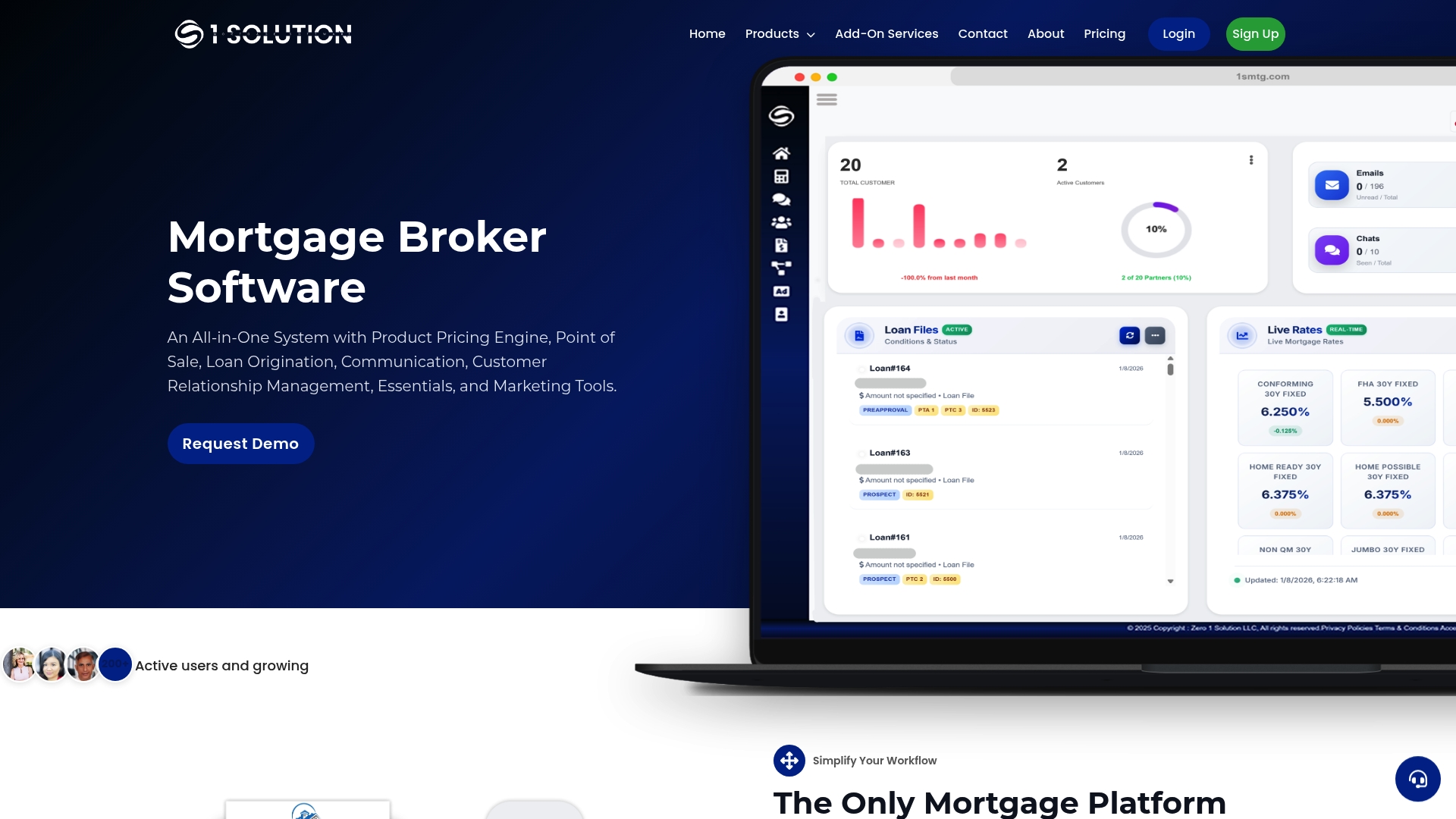
Our connected platform brings together:
- A borrower POS portal alongside our LOS and product pricing engine (PPE).
- CRM, marketing automation, and communication tools including email, SMS, and voice.
- Compliance tools, e-signature, and document storage in one ecosystem.
- Optional add-ons like a Mortgage Website, SMTP domain setup, and PBX solutions for an added fee.
Phone, text, and fax usage run at $0.10 per transaction. Visit our Subscription Account page to request a demo and see the platform configured around how your brokerage actually works.
FAQ
What are the benefits of using a loan origination platform?
A cloud-based loan origination platform speeds up processing by automating verifications and document handling, which reduces manual errors and shortens the time from application to closing. It also centralizes compliance tracking and borrower communication in one system instead of scattered tools.
What is the best software for processing mortgage loans?
There is no single universal answer since the right platform depends on whether you are a broker, lender, or bank, and on which integrations matter most to your workflow. Independent brokers often prioritize configurability and transparent pricing, which is the gap platforms like 1 Solution were built to address.
What is the 3-7-3 rule for a mortgage?
The 3-7-3 rule traditionally refers to disclosure timing under lending regulations: certain disclosures must go out within three business days of application, a waiting period occurs before closing, and a corrected disclosure requires another three-day wait if terms change significantly. Definitions of this rule vary by source, so confirm specifics against current regulatory guidance for your situation.
Is it worth becoming a mortgage loan officer?
Whether the career is worth pursuing depends on your market, compensation structure, and tolerance for commission-based income, which this article cannot assess for you. What is clear from the operations side is that loan officers working with modern cloud tools spend less time on paperwork and more time on client relationships, which changes the day-to-day experience significantly.
Sources
- Loan Product Advisor® - Freddie Mac Single-Family
- How Freddie Mac Is Powering Efficiency and Cost Savings Throughout the Loan Lifecycle - Freddie Mac
- TCS Digital Mortgage Suite