
CRM segmentation in a mortgage business means sorting your database into groups defined by loan facts and timing, so each group gets a reason to be contacted and a place in the call order. A list labeled "past clients" or "warm leads" tells you nothing about who to call today. A segment such as "ARM resetting within 12 months" does. The work is not hard, but it only holds up when the segments live inside the same system that holds your pipeline, your texts and your emails. That is how we built 1 Solution, and it is why we think segmentation belongs in your platform and not in a spreadsheet you export once a quarter.
TL;DR
- A useful segment is built from loan data (purpose, type, amount, occupancy, rate, closing date) and gives you a reason to call, not just a label.
- Cut the database four ways, then merge the cuts into one ranked call list instead of managing four separate lists.
- Time-sensitive segments go first: ARM resets, mortgage insurance removal, rate savings, expiring pre-approvals.
- Missing fields are a segment too. Work them on a schedule and fill them on every call.
- Segments only stay accurate if status changes (new application, closed, dead) update them automatically.
Table of Contents
- Why relationship labels do not produce calls
- The data worth segmenting on
- The four cuts, in order
- From four lists to one ranked call list
- What to do when the field is missing
- Match the message to the segment
- Keeping segments current as leads move
- A worked example
- How 1 Solution fits into this work
- Our perspective
- FAQ
- Sources
Why relationship labels do not produce calls
Most brokers start with labels: past client, sphere, realtor partner, cold lead. These describe who someone is to you. They do not describe what the person needs from you this month, and so they never produce a reason to dial.
A loan officer looking at 1,400 contacts tagged "past client" has two options: send everyone the same newsletter, or scroll and guess. Both waste time. The FICO Mortgage Credit Risk Manager's Best Practices Handbook makes the same point from the servicing side: a general outreach approach to all customers is easier to implement but wastes resources, while teams that segment by risk and target loans about to reset get more efficient results. It is a 2009 servicing document, so treat it as a principle rather than a playbook for origination, but the principle has not aged: segment by what the loan is doing, not by who the person is.
The fix is to build segments from fields that describe the loan and the borrower's situation. Then every segment answers one question: why would this person want to hear from me now?

The data worth segmenting on
You already collect most of what you need during the loan process. The federal HMDA data schema is a useful checklist of the basics, since it lists loan type, loan purpose, occupancy type and loan amount as core data fields. Those four fields are in nearly every file you have closed.
Build your segment fields from these groups:
- Loan facts: purpose (purchase, rate-and-term refinance, cash-out), loan type (conventional, FHA, VA, jumbo, ARM, HELOC), amount, occupancy (primary, second home, investment).
- Rate and term facts: note rate, closing date, ARM reset date, whether mortgage insurance is still in place, estimated loan-to-value.
- Borrower facts: credit score at last pull, employment type (W-2, self-employed), household goals noted on calls.
- Relationship facts: lead source, referring agent or partner, last contact date, last contact outcome, consent status for text and email.
- Pipeline facts: stage (new lead, pre-approved, in process, closed, lost), pre-approval expiration, next follow-up date.
The FICO handbook reports that segmenting by delinquency status, credit score and loan product type is a core practice for deciding whom to contact first. For an originator, the same logic maps to product type and credit profile: a self-employed borrower with a 2-1 buydown has a different next conversation than a W-2 borrower in a 30-year fixed.
The four cuts, in order
Work through the database in this sequence. Each cut narrows the list toward people with a concrete reason to talk.
Cut 1: Active pipeline versus everyone else
First separate anyone with a live file or an open conversation from the rest. These contacts belong in your pipeline workflow, not in marketing segments. Mixing them is how a borrower mid-process receives a "thinking about refinancing?" email. In 1 Solution, the LOS, CRM and communication tools sit in one platform, so the stage of the file and the contact record are the same record, which keeps this cut clean.
Cut 2: Closed loans by event, not by date alone
For everyone you have closed, ask what event could make them need a loan again:
- Rate event: the borrower's note rate sits well above the market.
- Reset event: an ARM or interest-only period is approaching adjustment.
- Equity event: enough time and appreciation have passed that cash-out or a HELOC makes sense.
- Insurance event: mortgage insurance may be removable as the balance approaches 80% of value.
- Life event: loan anniversary, a move, a growing household, a second home.
The Churchill Mortgage 2026 database-mining slides by Michael Brigagliano sort outreach this way. They put rate alerts showing 0.50% or more in savings, ARMs within 12 months of reset, and mortgage insurance removal at 80% loan-to-value in the high-priority group, and 12 to 24 month loan anniversaries, HELOC-to-cash-out conversions and expiring pre-approvals in the medium group. Use their tiers as a starting point and adjust the thresholds to your own pricing and borrower base.
Cut 3: Unclosed leads by where they stalled
Leads that never closed are not one group. Split them by the reason the file stopped:
- Not ready yet (credit, down payment, job history)
- Still shopping (got a quote, did not apply)
- Pre-approved, no contract
- Lost to another lender or paused by the seller side
The same slides recommend purchase-lead follow-up on 30, 60 and 90 day timelines, with pre-approval letters refreshed every 90 days. That gives each stalled-lead segment a built-in rhythm. For the conversion mechanics that follow, see our mortgage broker lead conversion process guide.
Cut 4: Referral partners and sources
Your agents, builders, CPAs and past clients who refer are a segment of their own, measured by referrals sent, not loans closed for them. Track lead source on every record. The same slides advise asking for a referral on every call and tracking referral sources, and that only works if the source field is filled in and reportable.
From four lists to one ranked call list
The mistake after segmenting is working four lists in parallel. A broker with limited call time needs one ordered list. Rank by urgency and value:
| Priority | Segment | Why it goes here | Typical action |
|---|---|---|---|
| 1 | ARM or interest-only reset within 12 months | Deadline is fixed and the borrower has a real payment change coming | Phone call, then a written comparison |
| 2 | Rate savings of 0.50% or more | Savings are concrete and can disappear as rates move | Call or text with an estimate |
| 3 | Mortgage insurance removal near 80% LTV | A clear monthly savings story | Call, then a short explainer email |
| 4 | Pre-approvals expiring soon | A buyer may be in contract elsewhere or about to lose the letter | Call, refresh the letter |
| 5 | Purchase leads at 30, 60 or 90 days | Timed follow-up keeps you in the running | Scheduled call or text |
| 6 | Loan anniversaries at 12 to 24 months | Soft, relationship-driven timing | Email and a personal note |
| 7 | Referral partners due for a touch | Compounds over time | Call, lunch, co-marketing |
The order is a judgment call, so rewrite it for your market. What matters is that the list is explicit, that the top rows are triggered by events and not by the calendar, and that a contact who fits two segments appears once, at the higher rank.
What to do when the field is missing
Every database has gaps: no closing date, no note rate, no loan purpose, a phone number that has changed. Do not wait for perfect data before you segment. Treat gaps this way:
- Segment the gap itself. Create a group such as "missing note rate" and "missing closing date". These are your data-repair lists.
- Fill from your own files first. Closed loans have the numbers in the LOS, so connect them to the contact record. This is a clear reason to keep CRM and LOS in one system: the data is already there and no one retypes it.
- Ask on every live conversation. A short, natural question during any call ("are you still in the house on Maple?", "what rate did you end up with?") fills the field and doubles as a touchpoint.
- Use a conservative default. If you cannot confirm the rate, place the contact in a lower-priority "unverified" tier, not in the top call list.
- Set a date to review. Gaps repaired once a quarter beat gaps never repaired.
Outdated data matters most in two places: contact permissions and pre-approval expiration. Before any text campaign, confirm consent on the record. Our mortgage texting compliance guide covers the A2P 10DLC registration and TCPA consent points that apply to mortgage texting in the U.S.
Match the message to the segment
A segment earns its keep when it changes what you say. Some pairings that work in practice:
- ARM reset segment: a plain-language payment comparison and an offer to review options, not a generic rate blast.
- Rate-savings segment: a short estimate of the monthly difference at the borrower's balance, with a call to action to book a time.
- Mortgage insurance segment: a note that their balance may be near the point where removal can be discussed, with a request to confirm the home's value.
- Stalled purchase leads: milestones tied to the 30, 60 and 90 day rhythm, such as a refreshed letter or a new-listing prompt.
- Referral partners: market updates they can pass to their own clients, and a thank you when a referral closes.
Channel follows urgency. High-priority segments get a call, with a text or email as the follow-up. Lower tiers get automated email sequences. If you are building those sequences, our mortgage drip campaign guide walks through cadence and content, and the rate alert alternatives guide covers how to trigger outreach when rates move.
Keeping segments current as leads move
Segments decay. A lead who applied last week should vanish from your "still shopping" list the moment the file opens. A loan that closes should enter your post-close segments automatically. If staff must move people by hand, the lists will be wrong within a month and the team will stop trusting them.
A maintenance routine that works:
- Define entry and exit rules for each segment. For example, "pre-approval expiring" begins 30 days before expiration and ends on renewal, application or loss.
- Tie segments to stage changes. When a file moves to closed, the contact should receive its post-close tags without anyone touching it.
- Log every contact and set the next date. The Churchill slides stress diligent CRM notes and firm follow-up dates. A segment with no follow-up date is only a list.
- Review monthly. Check which segments produced calls, applications and referrals. Retire the ones that do not and split the ones that are too broad.
- Keep a record of how contacts were tagged. Tags are also evidence of what you sent and why, which matters in a compliance review. We cover that in our guide to mortgage CRM tags and audit evidence.
If your current CRM cannot do this without exports and manual re-imports, moving is more manageable than most brokers expect. Our mortgage CRM migration guide lays out a 30-day approach that preserves audit trails and LOS links.
A worked example
Take a brokerage with 1,000 closed loans and 600 unclosed leads.
- Cut 1 removes 40 live files and sends them to the pipeline workflow.
- Cut 2 flags 35 ARMs with a reset in the next 12 months, 90 loans with a note rate at least 0.50% above the market, and 45 with balances near 80% of value.
- Cut 3 sorts the 600 leads: 120 are pre-approved with no contract, 210 are 30 to 90 days out from their last touch, and the rest are dormant.
- Cut 4 adds 25 referral partners, 6 of whom have not heard from you in 90 days.
The merged top list is not 1,640 names. It is roughly 170 people with a clear reason to call, ordered by urgency. One loan officer can work that list in a couple of weeks. These counts are illustrative, not benchmarks, but the shape is typical: a few hundred contacts hold most of the near-term business, and segmentation is how you find them.
How 1 Solution fits into this work

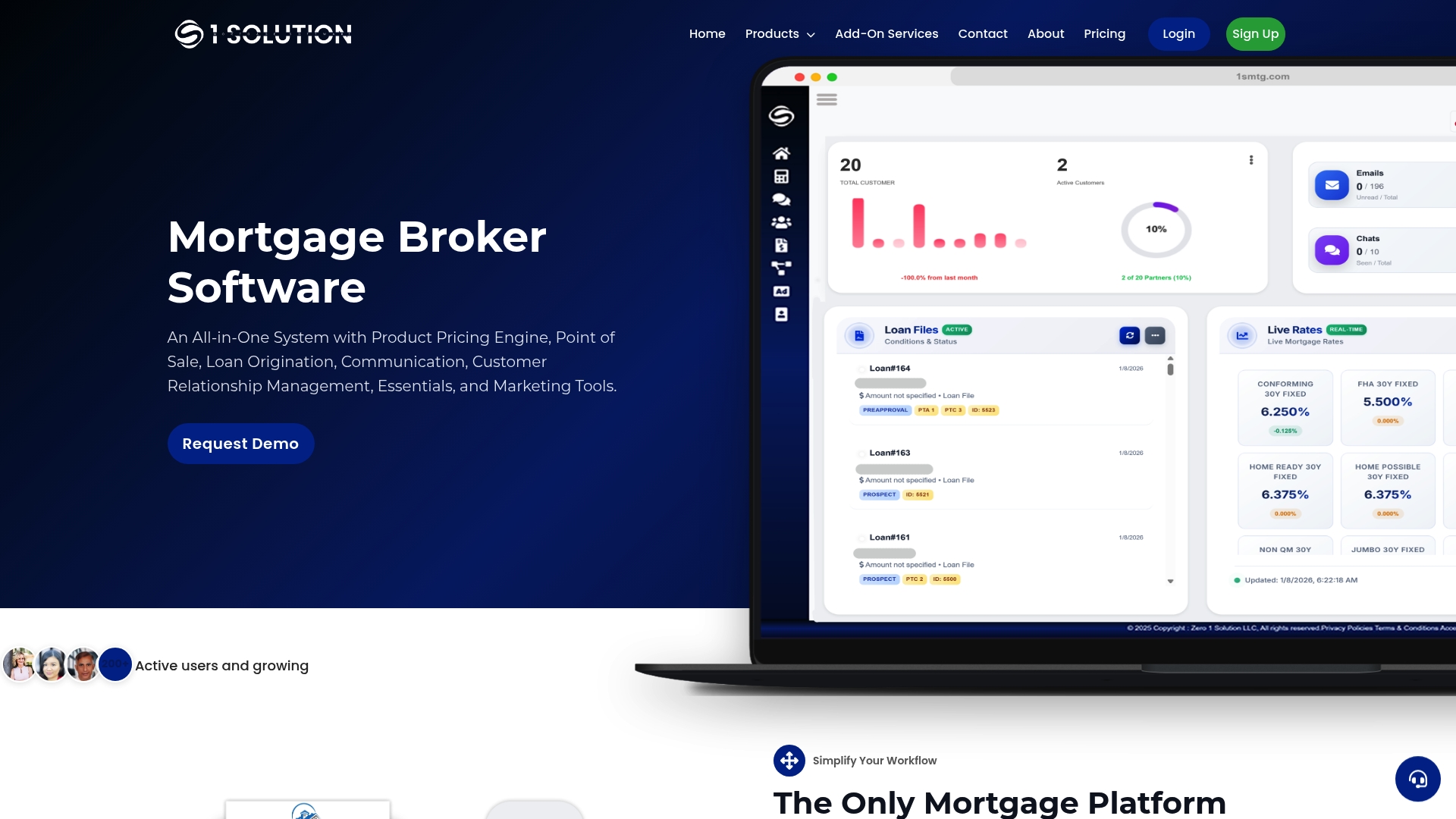
Segmentation fails most often at the seams between tools: the CRM does not know the loan stage, the texting tool does not know consent, the pricing tool does not feed the rate alert. 1 Solution is an all-in-one platform that brings pricing, CRM, communication, POS, LOS, compliance, marketing and operational tools into one connected ecosystem, built for independent mortgage professionals. Rate comparison, proposals and pre-approval generation, email, SMS, chat, voice and video, and lead and recruitment tracking sit alongside the CRM, so a segment can trigger a real action without an export.
Our platform is a subscription account, and communication usage is billed at published rates: $0.10 per text sent or received, $0.10 per minute on the phone system and $0.10 per fax sent or received. Onboarding is personalized, and you can talk to a person. If you want to see your own segments built on your own data, start at 1smtg.com.
Our perspective
Twenty years in mortgage operations as a processor, underwriter, loan originator and systems consultant taught me one thing about CRMs: the data is never the problem. Brokers already know their borrowers. What they lack is a system that connects what they know to what they do next.
Most mortgage software is built for banks and direct lenders, then sold to brokers as an afterthought. Brokers end up paying for a CRM, a point of sale, a pricing tool, a texting service and an e-signature tool, none of which agree on who the borrower is. Segmentation across that stack means exports, spreadsheets and guesses.
We built 1 Solution self-funded and independent, with no investors to answer to, so we could build it the way brokers actually work. Loan stage, contact history, pricing, communication and compliance live in one place. When a loan closes, the borrower's record is already there to segment. When a rate moves, the people it matters to are already grouped.
Control matters here. Your segments, your rules, your call order. A platform should carry out your judgment, not replace it.
Omar Khamisa
FAQ
What is CRM segmentation in mortgage?
It is the practice of grouping contacts in your CRM by shared loan facts, timing or relationship, such as ARM reset date, loan purpose or lead stage. Each group gets its own outreach and priority. The aim is to know whom to contact, why, and in what order.
How many segments should a mortgage broker have?
Start with fewer than ten. A handful of event-based segments (reset, rate savings, insurance removal, expiring pre-approval), a few lead-stage segments and one for referral partners cover most of the near-term business. Add a segment only when it changes what you say or when you say it.
Which data matters most for segmenting a mortgage database?
Loan purpose, loan type, amount, occupancy, note rate, closing date and last contact date. The first four are standard HMDA data fields, so they are usually already in your closed files. Note rate and closing date drive most of the event-based triggers.
Can I segment if my records are incomplete?
Yes. Segment the gaps as their own groups, fill them from your LOS files, and ask for the missing details during every call. Keep unverified contacts out of your top-priority list until the key fields are confirmed.
How often should I update my CRM segments?
Stage changes should update them automatically. Review the segment rules themselves monthly, checking which produced calls, applications and referrals, and adjust thresholds such as the savings level that triggers a rate alert.
Sources
- FICO Mortgage Credit Risk Manager's Best Practices Handbook (CDFI Fund)
- Modified LAR Schema, HMDA Documentation (FFIEC/CFPB)
- Database Mining slides, 2026 Summit (Churchill Mortgage)