

Realtor referral tracking means knowing, for every borrower a real estate agent sends you, who sent them, what happened next and what it was worth. For a mortgage broker, the best place to do that is inside the same system that holds the lead, the loan file and the follow-up, not in a separate spreadsheet or a stand-alone referral app. One record per borrower, tagged with the referring agent from the first call to funding, gives you the numbers and the paper trail without double entry. And because federal law limits what you can give back to a referral source, the record also has to be clean enough to show you gave nothing improper.
This guide is for brokers, brokerage owners and loan officers who get business from realtors. It covers what to capture, how to move a referral through stages, how to keep it compliant, and what to look for in software.
TL;DR
- Track every realtor referral as a stage-based record: received, contacted, application, in process, funded, lost. Tag it with the referring agent on day one.
- Log first contact, status changes and notes with timestamps. Most referrals are lost in the first days, and a timestamp is how you spot it.
- RESPA Section 8 bans paying or receiving anything of value for referring settlement-service business on federally related mortgage loans. Your tracking should measure relationships, never feed a payment.
- Referral tracking works best when it lives in your CRM and LOS, so the referral source follows the loan to closing and into reporting.
Table of Contents
- What realtor referral tracking actually has to answer
- Borrow the status model that real estate teams already use
- The fields that make a referral record useful
- Speed is the first thing to track
- Measure agents, not just loans
- Keep referral tracking on the right side of RESPA
- Why a spreadsheet or a stand-alone app breaks down
- What to look for in referral tracking inside a mortgage platform
- A simple weekly routine
- Our perspective
- How 1 Solution fits referral tracking
- FAQ
- Sources
What realtor referral tracking actually has to answer
The search results for this keyword are mostly built for agents sending clients to other agents, with referral fees and status updates between brokerages. Your situation is different. You are the lender or broker on the receiving end of a realtor's trust, and the agent wants to know their buyer is being looked after. You need to know which agents are worth your time.
A good tracking setup answers five questions at any moment:
- Who sent this borrower? The agent, their brokerage and, if relevant, the team.
- Where is the borrower now? Lead, pre-approval, under contract, in underwriting, clear to close, funded, or lost.
- Who touched it last, and when? This keeps a referral from sitting unanswered.
- What came of it? Loan amount, funded date, and the reason for any loss.
- Is the agent being kept informed? The agent's own client is on the line, so they need updates.
If your current system cannot answer these in under a minute, you have a tracking gap, not a marketing gap.
Borrow the status model that real estate teams already use
Agents are used to seeing referrals move through defined statuses. Keller Williams' own help guide for tracking referrals describes six statuses: Pending, Active, Funded, Lost, Expired and Rejected. It also describes a time-stamped activity log on every referral, with a required reason when a referral is marked Lost, and email notifications to the sender when the status changes.
That structure translates well to a mortgage pipeline. Here is a version built for a broker:
| Stage | What it means | What to record |
|---|---|---|
| New referral | The agent introduced a borrower | Agent, brokerage, date and time, how it arrived (call, text, email, portal) |
| Contacted | You spoke with the borrower | Time of first contact, borrower's goal, price range, timeline |
| Application | Borrower started a file | Application date, loan purpose, program |
| In process | Processing, underwriting, conditions | Milestone dates, rate lock, target closing date |
| Funded | Loan closed | Funded date, loan amount, loan type |
| Lost | Borrower went elsewhere or fell through | Required reason: rate, timing, credit, bought with another lender, other |
| Stalled | No response past your cutoff | Date last attempted, number of attempts |
Two details matter most. First, make the lost reason mandatory. A pile of unexplained losses teaches you nothing, while a pattern of "lost on speed" or "lost on rate" tells you what to fix. Second, keep the activity log append-only so entries are not overwritten. It is your proof of how fast you responded.
The fields that make a referral record useful
Keep the record short enough that loan officers will actually fill it in. A practical minimum:
- Referral source: the agent's name, brokerage and contact details, chosen from a list rather than typed freehand, so "Jen Alvarez" and "Jennifer Alvarez" never become two sources.
- Channel: a text from the agent, a warm introduction on a call, an open house sign-in, a co-branded landing page, or a returning client.
- Borrower consent to be contacted: note when and how the borrower agreed to hear from you. Our guide to mortgage eConsent covers capturing it before disclosures go out.
- Timestamps: received, first contact attempt, first live conversation, application, funding.
- Loan outcome: funded amount, or lost reason.
- Agent communication: whether the agent was updated, when and how.
The borrower's file belongs in your LOS. The referral tag simply has to travel with it, so you never need to re-key who sent the loan.
Speed is the first thing to track
A referral is a warm introduction that cools quickly. The agent has told their client that you will call. The borrower may also be speaking with other lenders the agent or a friend suggested.
So track speed to first contact for every referral, and review it weekly. A simple rule many teams adopt: a first attempt within an hour during business hours, a documented attempt by the end of the next business day, and a flag to a manager when neither happens. That cutoff is our suggestion rather than an industry standard. Pick one you can keep and have the system flag misses automatically rather than relying on memory.

Then close the loop with the agent. A short text when the borrower is contacted, another at pre-approval, and a heads-up when the file hits clear to close, keeps the agent from chasing you for status. It also shows the agent you are easy to work with, which drives the next referral.
Measure agents, not just loans
Once each loan carries its referring agent, you can build the report that matters: a ranking of your referral partners by results. For each agent, review:
- Referrals received in the last 12 months
- Percentage that reached application
- Percentage that funded
- Average days from referral to funding
- Funded volume
- Most common lost reason
This changes how you spend time. An agent who sends five referrals a year and converts all five deserves a call and a coffee. An agent who sends thirty, most of whom never respond, needs a different conversation about expectations. Neither shows up on a spreadsheet of closed loans alone.
We lay out a related approach in our post on the two-tracker system for mortgage referrals: one track for the referral relationship and one for the loan itself.
Keep referral tracking on the right side of RESPA
This is the part of realtor referral tracking that carries real consequences. The Real Estate Settlement Procedures Act (RESPA) Section 8 prohibits referral fees for settlement services in connection with federally related mortgage loans. Realtors and lenders are the classic pair it was written for.
The CFPB has been explicit about modern versions of the problem. Its advisory opinion, effective February 13, 2023, addresses digital mortgage comparison-shopping platforms. It says an operator violates Section 8 when it presents providers non-neutrally in a way that steers or influences the consumer's choice and the operator is paid at least in part for that referral activity. It adds that a higher fee for one provider's placement can be evidence of an illegal referral fee arrangement.
You are probably not running a comparison platform, but the principle applies to your tracking. Three practical rules follow:
- Track to measure, never to pay. A report showing which agents send you the most loans is fine for planning your relationships. Using that report to deliver cash, gifts or other value tied to referrals is where trouble starts. Our 8-step RESPA marketing checklist walks through the marketing side.
- Be careful with shared marketing costs. Co-marketing with an agent has to reflect each party's actual share and the actual value of what each receives. Document it separately from the referral record.
- Keep the lead source honest. If leads are distributed to loan officers or partners, the distribution rules need to be written and consistent. See our compliance-first guide to lead distribution.
The real estate side has its own rules. NAR's 2026 Code of Ethics, effective January 1, 2026, says a REALTOR® recommending services such as mortgage financing must disclose to the client any financial benefit or fee the REALTOR® or firm may receive directly as a result, other than real estate referral fees. Agents are therefore thinking about disclosure too, and a clear written record on your side helps them stay compliant.
For teams looking at how contracts and brokerage deals interact with RESPA, contract tools that limit RESPA risk is a useful angle on the legal limits of mortgage-related referrals. Compensation for your own loan officers is a separate rule set, covered in broker compensation rules and the loan originator compensation rule.
If you are unsure whether a specific arrangement with an agent is permissible, talk to your compliance officer or a mortgage compliance attorney before you start it. Software can keep the record. It cannot approve the arrangement.
Why a spreadsheet or a stand-alone app breaks down
Most brokers begin with a sheet: agent name, borrower name, date, status. It works for about a month. Then the problems show up:
- The borrower's real status lives in the LOS, so the sheet is always behind.
- Texts and calls with the agent are on someone's phone, not attached to the record.
- Two loan officers log the same agent under different spellings.
- Nobody can say how long a referral waited for a first call.
- When an examiner or a partner asks for the history, you reconstruct it from memory.
A stand-alone referral app fixes some of that but adds a new subscription and a second place to type. The loan is still somewhere else. Brokers who are already replacing multiple software subscriptions rarely want to add another, and the referral data is worth most when it sits next to the loan, the borrower communications and the marketing that goes back to the agent.
If you are also tightening up how your systems are run and protected, an IT partner can help with operational recordkeeping and security for a real estate or mortgage office, such as backups and access controls for the records described here.
What to look for in referral tracking inside a mortgage platform
Whether you are adding tracking to a CRM you already use or choosing a new platform, check these items:
| Requirement | Why it matters |
|---|---|
| Referral source on every contact and loan | Reporting by agent depends on it |
| Source list that is controlled, not free text | Prevents duplicate agents and messy reports |
| Stage tracking tied to actual loan milestones | Statuses update without retyping |
| Time-stamped activity log | Proves speed and shows who did what |
| Calls, texts and email logged to the record | The history stays in one place |
| Reminders and alerts for stalled referrals | Catches a referral before it goes cold |
| Borrower consent captured and stored | Supports compliant outreach |
| Role-based access | Loan officers see their files, owners see the whole book |
| Reports by agent, brokerage and period | Tells you where to invest |
| One login for CRM, LOS, POS and e-signature | Fewer subscriptions and no double entry |
The last row matters more than it looks. Each extra system is another place a referral tag can be dropped.
If you are a business owner who needs customer relationship, scheduling and messaging tools for local services more broadly, a unified local business platform shows how these functions are bundled elsewhere. For mortgage work, you need the loan side connected as well.
A simple weekly routine
Systems only help if someone uses them. A routine that takes about 30 minutes:
- Monday: Open every referral still in New or Contacted. Anything without a documented contact attempt gets a call that day.
- Midweek: Update agents on files in process. One line each: where it is, what is pending.
- Friday: Review lost referrals from the week and confirm each has a reason.
- Monthly: Run the agent ranking. Pick the top five to thank personally, within the limits of RESPA, and the five with the lowest conversion to talk to.
- Quarterly: Review the lost reasons overall. If speed or rate keeps appearing, change something.
Our perspective
We built 1 Solution because brokers kept telling us the same thing: they were paying for a CRM, a POS, a pricing engine, a texting tool and an e-signature tool, and none of them agreed on who a borrower was. Referral tracking is where that hurts most. The agent sent you a borrower, the borrower is in your LOS, the conversation is in someone's texts, and the report you want does not exist.
After more than 20 years working as a processor, underwriter, loan originator and systems consultant, I can tell you that referral partners care about two things: did you call my client, and did you take care of them. Both come down to a timestamp and a status that someone can find. When pricing, CRM, communication, POS, LOS and compliance tools sit in one connected platform, the referral source goes with the borrower from the first contact to the closing table, and you stop reconciling five systems to answer a simple question.
We are self-funded and independent, and we design for brokers, not for banks. That means the control stays with you: your data, your partners, your process, your compliance posture.
Omar Khamisa
How 1 Solution fits referral tracking
1 Solution is a cloud-based platform for brokers and lenders that brings the CRM, loan origination system (LOS), borrower portal (POS), product pricing engine, e-signature and compliance tools into one place. It also includes lead and recruitment tracking, partner and vendor management, an employee dashboard, and email, SMS, chat, voice and video communication. That means a realtor's referral can be captured as a lead, followed through the borrower portal and the loan file, and communicated about from one system.
Communication usage is priced as published on our site: $0.10 per minute for the phone system and $0.10 per text message sent or received. Subscription pricing is set through an account, and onboarding is personalized.
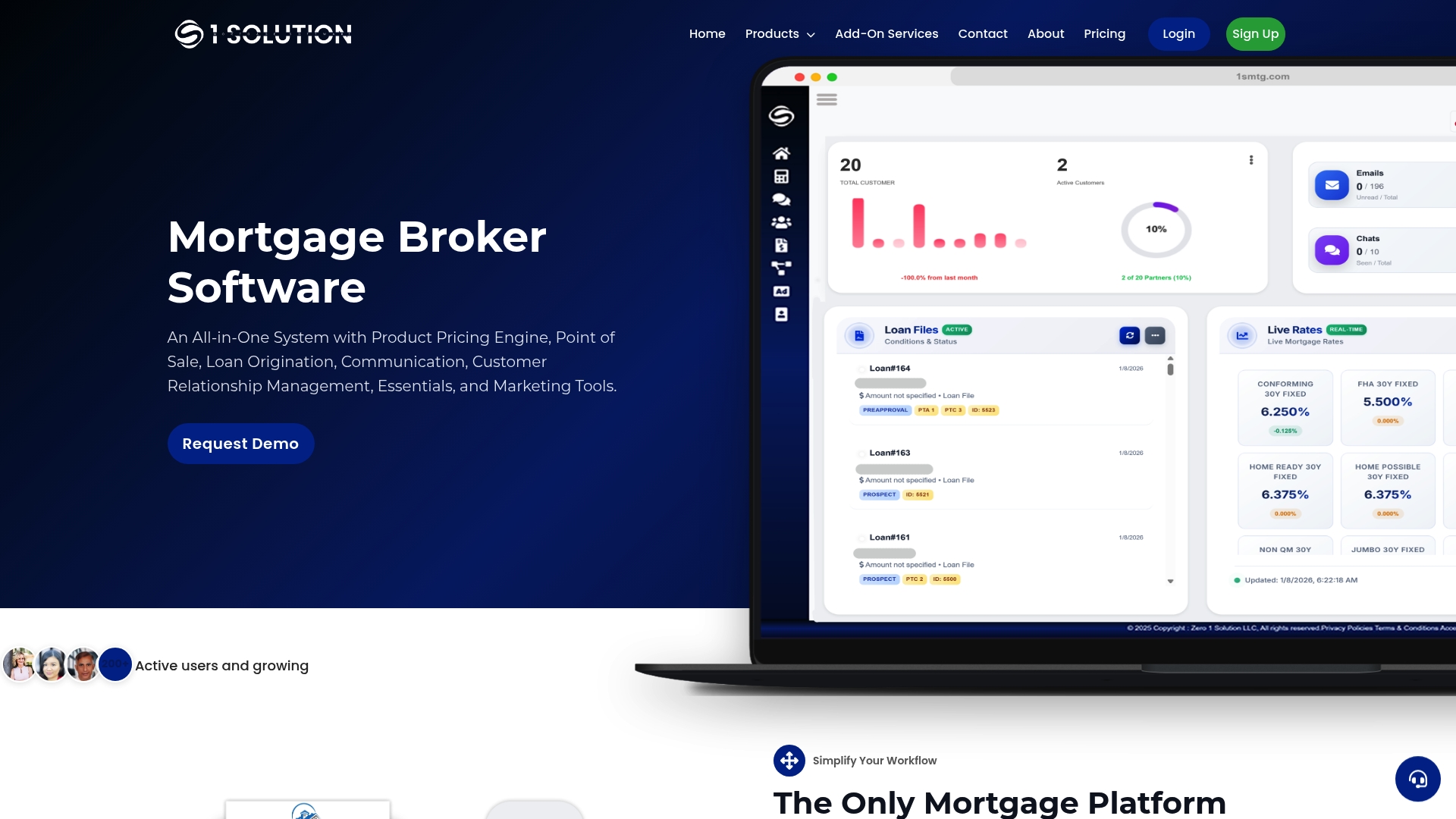
If you want to see how your realtor referral flow would run on one platform, start at 1smtg.com.
FAQ
What is the best way to track realtor referrals as a mortgage broker?
Use a stage-based record in your CRM or LOS, with the referring agent chosen from a controlled list and every contact time-stamped. Add a mandatory reason for lost referrals. When the referral source sits on the loan itself, reporting by agent takes no extra data entry.
Can I pay a realtor for sending me a borrower?
No, not for a referral on a federally related mortgage loan. RESPA Section 8 prohibits referral fees for settlement services, and the CFPB's 2023 advisory opinion shows how closely it looks at payments tied to referral activity. Ask your compliance officer or attorney before setting up any arrangement with an agent.
What should a referral tracking record include?
The referring agent and brokerage, how the referral arrived, borrower consent to be contacted, timestamps for receipt and first contact, current stage, loan outcome and, if lost, the reason. A time-stamped activity log of calls, texts and notes ties it together.
How fast should I respond to a realtor referral?
As fast as you can keep up consistently. A common internal standard is a first attempt within an hour in business hours and a documented attempt by the next business day. Set the rule, flag misses automatically and review the speed numbers weekly.
Do I need a separate referral app?
Not if your CRM and LOS can carry the referral source with the loan and report on it. A separate app tends to create a second record that falls behind the loan file.
Sources
- Track and Manage Your Referrals, KW Answers
- Federal Register, Vol. 88, No. 29: CFPB RESPA advisory opinion, effective February 13, 2023
- NAR 2026 Code of Ethics and Standards of Practice