
Training resources matter because they let new hires contribute faster, make fewer costly mistakes, and stay longer. Only 22% of organizations describe their onboarding as highly effective, which means most teams are absorbing the full cost of slow ramp, repeated errors, and early turnover without realizing it. For HR professionals and managers, that gap is both a risk and an opportunity.
The three outcomes that justify investment in training resources:
- Time-to-productivity: Structured resources cut the time before a new hire works independently.
- Error reduction: Documented SOPs and just-in-time guides reduce rework and compliance gaps.
- Retention: New hires who receive clear development paths are less likely to leave within the first 90 days.
Platforms like 1 Solution Mortgage Software demonstrate the principle in practice: when CRM, LOS, and compliance tools are integrated into a single environment, new hires learn one connected system instead of juggling five separate ones, and ramp time drops accordingly.
Key Takeaways
Structured training resources are the single most controllable lever HR and managers have to reduce ramp time, cut early turnover, and protect the organization from compliance risk.
| Point | Details |
|---|---|
| Start with a role task audit | Map every task the hire will own in 90 days before building any content. |
| Sequence learning across phases | Deliver resources in three phases (0–7, 8–30, 31–90) to prevent overload and improve retention. |
| Measure what actually matters | Track time-to-first-independent-task, error rate, and early turnover, not just completion rates. |
| Assign named owners | Every SOP and training module needs one person responsible for keeping it current. |
| 1 Solution Mortgage Software | An integrated mortgage platform that consolidates LOS, CRM, and compliance tools reduces new-hire ramp by eliminating multi-system fragmentation. |
Table of Contents
- What do "training resources" actually mean for new hires?
- Why training resources benefit both employees and your organization
- What every new-hire training program should cover
- How to build an effective new-hire training program, step by step
- Who should train new hires, and how to divide the work
- How to measure the impact of training resources and prove ROI
- Common pitfalls when creating training resources, and practical fixes
- How technology supports scalable new-hire training
- Practical best practices to sustain onboarding as a learning journey
- Designing new-hire training for mortgage broker teams: a practical template
- Why I prioritize training as an operations leader
- How an integrated mortgage platform can simplify new-hire onboarding
- Sources
What do "training resources" actually mean for new hires?
The phrase gets used loosely, so let's be precise. Orientation is logistics: paperwork, badge access, benefits enrollment, a tour of the office. Training resources are everything that builds role competence after the first day. The distinction matters because organizations that conflate the two tend to stop investing once orientation ends, leaving new hires to figure out the actual job on their own.
Training Industry describes onboarding as a strategic learning experience that should extend across the first several months, combining structured learning, manager support, and practical application. That framing is more useful than the single-event model most teams default to.
Common training resource types, with a brief example of each:
- Standard Operating Procedures (SOPs): A written, step-by-step guide for a recurring task, such as a rate lock request or a borrower intake workflow.
- Microlearning modules: A 3–5 minute video or interactive lesson covering one concept, like how to read a loan estimate.
- LMS courses: Sequenced, trackable e-learning delivered through a learning management system, often used for compliance training.
- Job aids and checklists: Single-page reference cards a hire keeps open during their first live tasks.
- Shadowing plans: A structured schedule of who to observe, for how long, and what to look for, rather than open-ended "follow someone around."
- Coaching guides: Manager scripts and question prompts for weekly check-ins during the first 90 days.
- Tool-specific walkthroughs: Step-by-step guides for daily systems, such as a CRM pipeline view, a pricing engine, or a LOS document upload workflow.
Ohio State's L&D guidance recommends blended onboarding that combines instructor-led sessions, self-paced learning, experiential practice, and peer coaching. No single format covers every learning need, and the mix is what makes resources stick.
Why training resources benefit both employees and your organization
The case for investment works at two levels simultaneously, and the strongest arguments for budget approval live at the organizational level.
Employee-level benefits
New hires who receive structured training resources reach competence faster and with less anxiety. They understand what good performance looks like before their first performance conversation, which means they can self-correct rather than waiting for feedback. Clarity about expectations also connects directly to engagement: when people know what they are supposed to do and have the tools to do it, they show up differently.

Pew Research found that a majority of workers who quit in 2021 cited lack of advancement opportunities and feeling disrespected as top reasons for leaving. Training resources signal the opposite: that the organization has invested in the hire's growth, not just their output.
Organizational benefits
The cost side is where HR leaders win budget conversations. Consider what poor onboarding actually costs:
- Extended ramp time: A new loan originator spending four weeks at 40% productivity instead of two weeks is a measurable revenue gap.
- Manager interruption load: Without searchable SOPs and job aids, new hires ask the same questions repeatedly. That time is invisible on a P&L but real in every manager's calendar.
- Early turnover: Replacing a mid-level hire typically costs 50–200% of annual salary when recruiting, training, and lost productivity are counted together.
- Compliance errors: In regulated industries, an undertrained hire's mistake can trigger regulatory review, not just rework.
SHRM's research links mature onboarding strategies to measurable improvements in retention and engagement. Organizations that treat onboarding as a strategic function, not an administrative one, see those gains compound over time.
HBR argues that training pays off twice: once for the employee who gains capability, and again for the manager who can delegate more and scale their own output. Most ROI calculations miss the second effect entirely.
| Benefit | Who gains | Practical signal |
|---|---|---|
| Faster competence | Employee | Days to first independent task |
| Higher engagement | Employee | 30-day survey score |
| Shorter ramp | Organization | Time-to-full-productivity |
| Fewer errors | Organization | Rework and correction rate |
| Lower early turnover | Organization | 90-day retention rate |
| Reduced manager load | Manager | Hours answering onboarding questions |
What every new-hire training program should cover
A program that skips any of these components leaves a gap that shows up later, usually as a performance problem or a compliance incident.
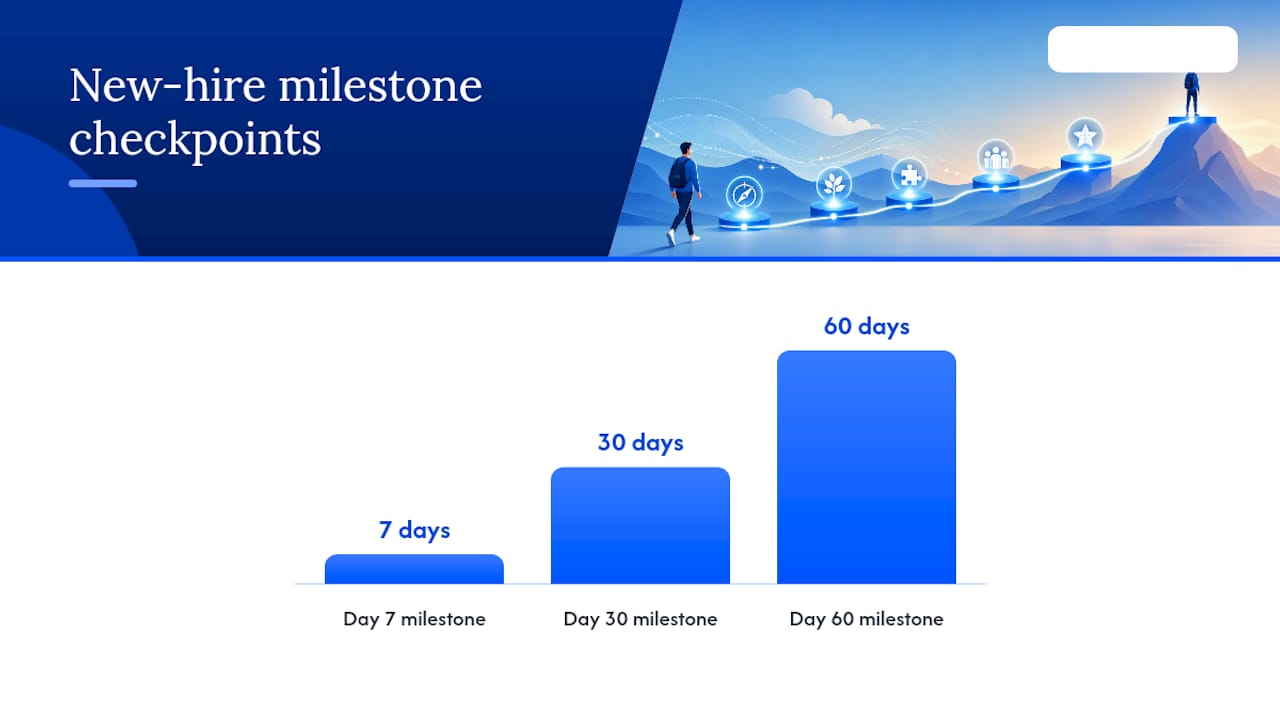
- Role clarity and milestones. Define what success looks like at day 7, day 30, and day 60 before the hire starts. Milestones give both the manager and the new hire a shared reference point for progress conversations.
- Process and workflow SOPs. Every recurring task the hire will own needs a documented procedure. Undocumented tribal knowledge is the single biggest source of inconsistency across teams.
- Systems and tools training. CRM navigation, LOS document management, pricing engine inputs, and any compliance platform the hire will touch daily. Delivering tool training just-in-time rather than in week one reduces cognitive overload and improves retention of the material.
- Manager coaching and peer support. Structured check-ins, not open-door assumptions. A 15-minute weekly conversation with a defined agenda does more than an informal "let me know if you need anything."
- Policy and compliance essentials. Where to find the employee handbook, who to contact for compliance questions, and which regulatory requirements apply to the role. For mortgage teams, this includes RESPA, TRID, and state licensing obligations.
- Assessment and feedback points. Knowledge checks after each module, a practical observed task before sign-off, and a formal 30-day review. Completion rates without comprehension checks are a false signal.
Pro Tip: Build a "day one survival kit" for each role: a single-page reference card with the five most common tasks, the three people to call for help, and links to the top five SOPs. New hires use it constantly in the first two weeks, and it cuts repeat questions to managers by a measurable margin.
How to build an effective new-hire training program, step by step
Trainual's playbook on reducing time-to-productivity makes the case clearly: documented systems, sequenced learning, and searchable SOPs outperform shadowing-based onboarding on every measurable dimension. Here is the sequence that works.
-
Assess needs. Conduct a role task audit. List every task the hire will perform in the first 90 days, rank by frequency and risk, and identify where documentation is missing or outdated. This audit becomes the content backlog.
-
Define outcomes. Write concrete milestones for day 7, 30, and 60. "Understands the LOS" is not a milestone. "Can submit a complete loan file without manager review by day 30" is. Outcomes drive content decisions and give managers a coaching framework.
-
Design the program. Sequence content from foundational to complex. Use mixed formats: a short video for context, a written SOP for reference, a shadowing session for observation, and a live task for practice. Avoid front-loading. AIHR recommends delivering role-specific resources as the hire needs them, not all at once in week one.
-
Assign delivery owners. HR or L&D owns structure, materials, and tracking. The hiring manager owns context, performance conversations, and practical coaching. Peer mentors handle day-to-day questions and cultural integration. Subject-matter experts deliver tool-specific walkthroughs. When ownership is ambiguous, delivery fails.
-
Verify comprehension. A quiz completion rate is not a competency signal. Add observed tasks: watch the hire complete a real workflow before signing off. For compliance-sensitive roles, require demonstrated performance, not just module completion.
-
Iterate. Collect feedback at day 7, day 30, and day 90 using a short structured survey. Review materials quarterly and assign a named owner to each SOP so updates happen on schedule rather than when someone notices the content is wrong.
Pro Tip: Run a 30-minute "confusion audit" with your last three new hires before you build new content. Ask them to list the five questions they asked most in their first month. Those five questions are your highest-priority documentation gaps.
Who should train new hires, and how to divide the work
Ownership confusion is one of the most common reasons onboarding programs fail. When everyone assumes someone else is handling it, the new hire gets inconsistent information and no clear point of contact.
The clearest model assigns four distinct roles:
- Hiring manager: Owns context and performance. Explains why the role exists, sets expectations, conducts weekly check-ins, and delivers the 30/60/90 milestone conversations. The manager is the hire's primary accountability partner, not just a resource.
- HR and L&D: Owns structure, materials, compliance training, and tracking. Builds the program, maintains the LMS, monitors completion rates, and flags gaps. HR is the architect; the manager is the builder.
- Peer mentor: Handles day-to-day questions, cultural navigation, and the informal knowledge that never makes it into an SOP. A structured mentor pairing with a defined 90-day scope works better than an open-ended "buddy" assignment. Mentorship in loan officer development follows the same principle: defined scope, clear handoff, measurable check-ins.
- Subject-matter experts (SMEs): Deliver tool-specific and process-specific training. A senior processor walking a new hire through the LOS document checklist is more credible and more efficient than a generic e-learning module.
For teams using an integrated platform like 1 Solution Mortgage Software, the platform itself plays a supporting role: system-embedded guides, role-specific dashboards, and document storage reduce the volume of questions that would otherwise reach the manager or SME.
Pro Tip: Give managers a three-question check-in script for their weekly conversations: "What went well this week? Where did you get stuck? What do you need from me?" It takes seven minutes and surfaces problems before they compound.
How to measure the impact of training resources and prove ROI
Most training programs are measured by completion rates. That is the wrong metric. Completion tells you the hire watched a video. It tells you nothing about whether they can do the job.
The KPIs that actually matter:
- Time-to-first-independent-task: How many days before the hire completes a core task without manager assistance? Set a target by role before the hire starts.
- Time-to-full-productivity: The date the hire reaches the output standard for their role. Track it against the pre-hire estimate.
- Error and rework rate: Count corrections, resubmissions, and compliance flags in the first 90 days. Compare cohorts trained under different program versions.
- Early turnover rate: Separations within 60–180 days. Segment by manager, role, and hire source to identify where the program is failing.
- Manager time on onboarding questions: Ask managers to log interruptions for two weeks at the 30-day mark. The number is usually surprising and makes a strong budget argument.
- Training completion rate: Useful as a process health check, not a competency signal.
Secondary KPIs worth tracking: onboarding NPS (a single "how likely are you to recommend this onboarding experience?" question at day 30), engagement survey items at 60 days, and internal mobility rate at 12 months.
HBR's analysis of training ROI highlights that organizations consistently undercount the manager-level effect. When a well-trained hire reduces the manager's daily interruption load by two hours per week, that is roughly 100 hours of senior-staff time recovered per quarter. At a fully loaded cost of $75 per hour, that is $7,500 per new hire per quarter, a figure that rarely appears in training ROI calculations but is entirely real.
| KPI | What it measures | Data source | Reporting cadence |
|---|---|---|---|
| Time-to-first-independent-task | Days to unsupported task completion | Manager log | At day 30 |
| Time-to-full-productivity | Days to role output standard | Manager and HR review | At day 60 and 90 |
| Error and rework rate | Corrections in first 90 days | System logs or manager record | Monthly |
| Early turnover rate | Separations within 180 days | HRIS | Quarterly |
| Manager interruption load | Hours answering onboarding questions | Manager self-report | At day 30 |
| Onboarding NPS | Hire satisfaction with onboarding | Survey | Day 30 |
Pro Tip: Build your ROI case before you need budget approval. Track one cohort through the full 90 days with these KPIs, then present the cost-per-hire-ramp calculation alongside the program cost. The numbers make the argument better than any slide deck.
Common pitfalls when creating training resources, and practical fixes
The problems are predictable. So are the solutions.
- Information overload in week one. Dumping every policy, tool, and process on a new hire in the first five days guarantees they retain almost none of it. Fix: sequence content across 90 days and deliver role-specific resources at the moment of need, not before. AIHR's just-in-time learning model is the right framework here.
- Undocumented tribal knowledge. The most experienced person on the team knows how things actually work, and none of it is written down. When that person is unavailable, the new hire is stuck. Fix: run a knowledge-capture session with your top performers before the next hire starts. Record the session, then convert it to a searchable SOP.
- Inconsistent manager involvement. Some managers run structured check-ins; others assume the hire will ask if they need help. The result is wildly different onboarding experiences for the same role. Fix: give every manager a 90-day check-in calendar and a three-question script. Standardize the structure without scripting the conversation.
- Outdated content. An SOP written 18 months ago for a tool that has since been updated is worse than no SOP, because it actively misleads the hire. Fix: assign a named owner to every document and schedule a quarterly review. If no one owns it, it will not get updated.
- Front-loading compliance training. Delivering all required compliance modules in week one means the hire completes them before they have any context for why the rules exist. Fix: sequence compliance training to coincide with the first time the hire performs the relevant task.
Pro Tip: Create a "stale content" flag in your knowledge base. Any document not reviewed in 90 days gets flagged automatically. The flag is visible to the document owner and to HR. It takes five minutes to set up and prevents the "we forgot to update it" problem entirely.
How technology supports scalable new-hire training
The right tools reduce manager burden, track progress automatically, and deliver resources at the moment a hire needs them. The wrong tools create another system no one uses.
The main categories and what each one actually does:
- Learning Management Systems (LMS): Deliver, track, and report on structured courses. Strong for compliance training and sequenced onboarding modules. Weak for just-in-time reference, because most LMS platforms are not designed for quick search during a live task.
- Digital Adoption Platforms (DAPs): Overlay step-by-step guidance directly inside daily tools like a CRM or LOS. The hire sees the instruction while performing the task, which is the highest-retention delivery method available. Software training for loan officers increasingly uses DAPs for exactly this reason.
- Knowledge bases: Searchable repositories of SOPs, job aids, and reference documents. The value is in search speed: a hire who can find the answer in 30 seconds does not interrupt the manager. Confluence, Notion, and Guru are common platforms in this category.
- Microlearning authoring tools: Create short, focused learning objects (video, interactive, or scenario-based) that cover one concept at a time. Articulate 360 and Camtasia are widely used options.
- Onboarding checklist platforms: Structured task lists with due dates, owner assignments, and completion tracking. Workday, BambooHR, and dedicated onboarding tools like Sapling handle this well.
- CRM and LOS-integrated guides: Role-specific walkthroughs embedded directly in the platform the hire uses daily. For mortgage teams, this is the highest-leverage technology investment because it eliminates the gap between "learning about the tool" and "using the tool."
Selection criteria that matter most: integration with the hire's daily tools, search speed, mobile access, and reporting granularity. A platform that tracks completion but not comprehension is only solving half the problem. Mortgage automation tools that combine workflow automation with embedded guidance reduce both ramp time and error rates in parallel.
Practical best practices to sustain onboarding as a learning journey
Onboarding is not an event. The programs that produce the best 90-day outcomes treat it as a phased process with distinct objectives at each stage.
- Phase 1 (days 0–7): Orient and stabilize. Cover logistics, introductions, system access, and the day-one survival kit. The goal is confidence, not competence. Do not introduce complex workflows yet.
- Phase 2 (days 8–30): Build core competency. Deliver role-specific SOPs, tool walkthroughs, and the first observed task. The hire should complete at least one real workflow independently by day 30.
- Phase 3 (days 31–90): Develop and integrate. Introduce edge cases, compliance nuances, and stakeholder relationships. The hire should be at or near full productivity by day 90, with a clear path to the 6-month milestone.
Use mixed modalities across all three phases. A hire who only watches videos will not perform as well as one who watches, reads, observes, and then does. Repeat exposure matters: a concept introduced in week one and reinforced in week three is retained far better than one covered once.
The Training Associates recommend 30/60/90 milestones, mentor support, and blended modalities as the highest-impact, lowest-cost practices available to managers. None of them require a large budget. They require planning and consistency.
Pro Tip: Schedule a "content owner" meeting at the end of every quarter. Bring together the managers, SMEs, and HR lead who own training materials. Give each person 10 minutes to flag what has changed in their area. The meeting takes an hour and prevents six months of outdated content from misleading your next cohort.
Designing new-hire training for mortgage broker teams: a practical template
Having spent over 20 years working across mortgage operations as a processor, underwriter, loan originator, and systems consultant, Omar Khamisa built 1 Solution Mortgage Software specifically because the training and onboarding problems in mortgage brokerages are structural, not incidental. The template below reflects what actually works in a brokerage environment.
Day 0–7 checklist
- System access: LOS login, pricing engine credentials, CRM pipeline view, compliance platform, and document storage.
- Introductions: processor, underwriter contact, compliance officer, and at least one senior originator as peer mentor.
- Day-one survival kit: rate lock SOP, borrower intake workflow, escalation contact list, and compliance quick-reference card.
- Shadowing: two live borrower intake calls with a senior originator, with a debrief after each.
- First milestone conversation with the hiring manager: what does success look like at day 30?
Systems training plan (days 8–30)
- Pricing engine: Input a sample scenario, read the output, and generate a rate comparison. Observed task: produce a compliant rate proposal for a test borrower file.
- LOS: Upload a complete document package, track file status, and submit for processing. Observed task: submit a clean file without manager review.
- CRM: Enter a new lead, log a borrower communication, and set a follow-up task. Observed task: manage a five-lead pipeline for one week independently.
Loan officer onboarding program examples that follow this structure consistently produce shorter ramp times than shadowing-only approaches.
30/60/90 milestone tasks
- Day 30: Complete one loan file from intake to submission without manager assistance. Pass the compliance module assessment.
- Day 60: Manage a pipeline of 8–10 active files. Identify and escalate one compliance question independently.
- Day 90: Reach the team's standard output rate. Complete a peer knowledge-share session on one SOP they improved or documented.
Role-specific handoffs
- Processor touch: Introduce the processor at day 3. The originator should understand what a clean file looks like from the processor's perspective before submitting their first real file.
- Underwriter touch: Shadow one underwriting condition review by day 21. Understanding why conditions are issued changes how originators structure files.
- Compliance officer touch: A 30-minute Q&A session at day 14, focused on the three most common compliance questions new originators ask.
The role of staff training in mortgage companies is not a soft investment. In a regulated, relationship-driven business, an undertrained originator is a compliance risk and a client retention problem simultaneously.
Why I prioritize training as an operations leader
The operational argument for training investment is straightforward: an undertrained hire costs more than a trained one, every single time. The cost shows up in manager time, compliance incidents, rework, and early turnover. None of those costs appear on a training budget line, which is exactly why they are so easy to ignore until they compound.
The compliance argument is equally direct. In mortgage operations, a new hire who does not understand TRID disclosure timing or RESPA referral rules is not just making an error. They are creating regulatory exposure for the entire brokerage. Training resources are not a courtesy. They are a risk management tool.
The culture argument is the one that gets overlooked most often. When a new hire receives structured resources, a mentor, and clear milestones, they experience the organization as one that takes their development seriously. That experience shapes their engagement, their loyalty, and their willingness to stay when a competitor calls.
Pro Tip: Embed role-specific SOPs directly into the daily dashboard your team uses. If the SOP is one click away from the task it supports, it gets used. If it lives in a shared drive three folders deep, it does not.
How an integrated mortgage platform can simplify new-hire onboarding
When a new hire joins a brokerage running five separate tools, they are not learning one job. They are learning five systems simultaneously, each with its own login, interface, and logic. That fragmentation is one of the most underestimated sources of ramp delay in mortgage operations.
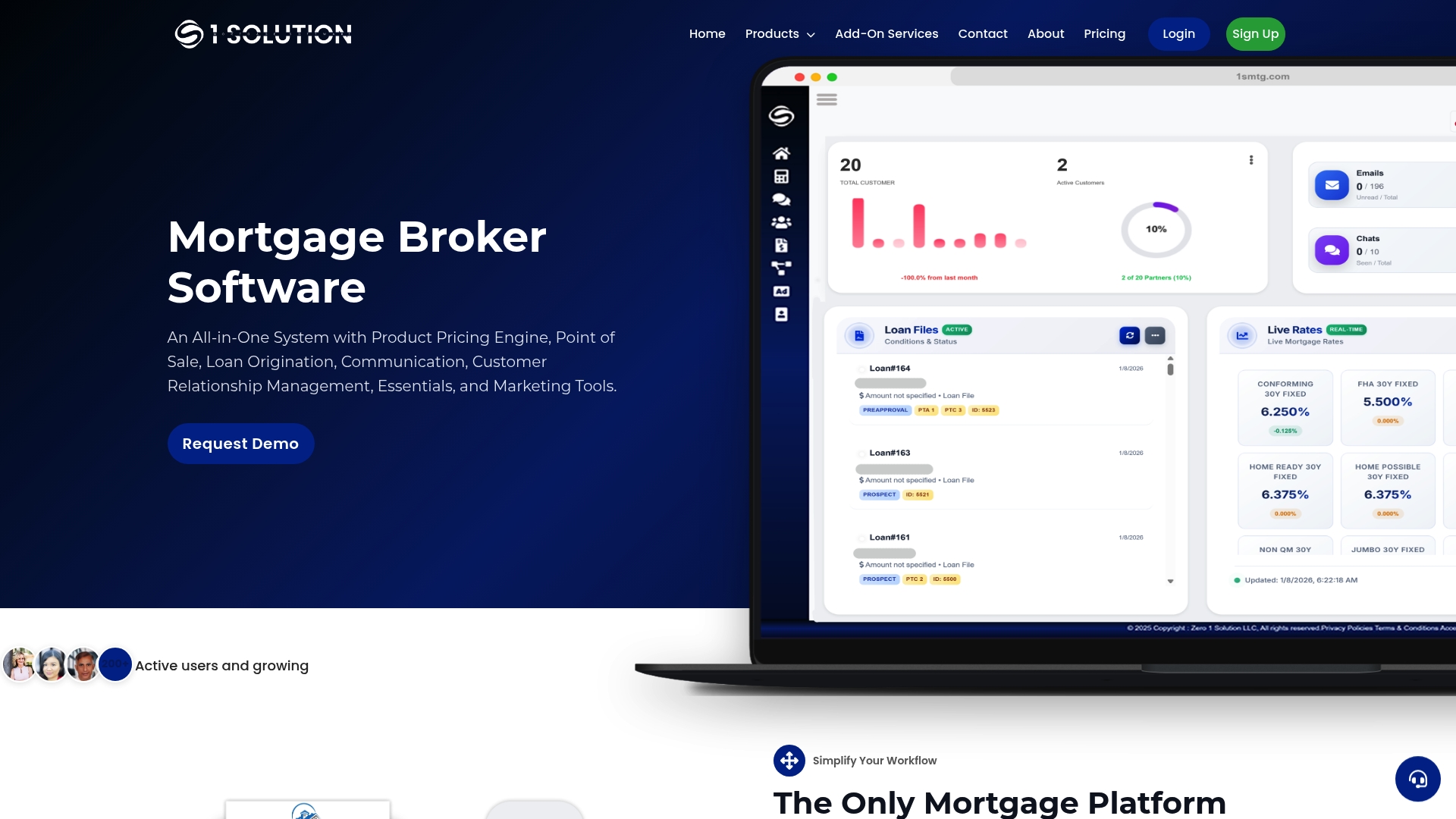
1 Solution Mortgage Software was built to solve exactly that problem. By combining LOS, CRM, pricing engine, borrower POS portal, compliance tools, document storage, and communication in one connected platform, new hires learn a single environment rather than a patchwork of disconnected systems. The employee dashboard surfaces role-specific tasks and resources in one place, which means the training resources you build are accessible at the moment of need, not buried in a separate system.
For brokerages that want to see how an integrated platform reduces ramp time and centralizes training assets, a demo of 1 Solution Mortgage Software is a practical starting point. Visit 1smtg to schedule a walkthrough and see how the platform supports new-hire onboarding from day one.
Sources
These are the primary references used throughout this article. Each one is worth reading in full if you are building a budget case or designing a program from scratch.
- Employee Onboarding Guide for L&D Leaders - Training Industry, Inc.
- Why training employees pays off twice — Harvard Business Review
- How to Reduce New-Hire Time to Productivity 2026 - Trainual
- Training new employees - AIHR
- 2022 Workplace Learning and Development Trends Report - SHRM
- Majority of workers who quit a job in 2021 cite low pay, no opportunities for advancement, feeling disrespected - Pew Research Center