
Document version control for mortgage files means tracking every change to a loan document, who made it, when, and which copy counts as official, so your team never underwrites, closes, or sells a loan using a stale or wrong file. The single best first step is building a central, metadata-driven repository with an immutable audit trail. That one move stops the two failures that cause most examiner findings and investor kickbacks: duplicate "authoritative" copies and missing change history.
TL;DR:
- Automated, metadata-driven version control with immutable audit trails reduces errors and compliance risks more effectively than manual tracking systems.
- Critical components include a centralized repository, role-based permissions, check-in/check-out workflows, and SMART Doc verifiable profiles for authoritative copies.
- Early implementation should focus on a pilot group with clear metadata schema design, workflow controls, and regular audits within 30 days of go-live.
- Version control must sync immediately with LOS, e-signature platforms, and document portals, ensuring authoritative copies are recognized across systems.
- Retention policies require mapping document types to specific periods, automating disposition, and maintaining change logs to meet regulatory and audit standards.
Table of Contents
- Core Concepts and Terminology You Need to Align On
- Why Robust Version Control Matters for Mortgage Lending
- Essential Components of a Mortgage Document Version Control System
- Implementation Best Practices: A Phased Rollout Plan
- How Version Control Connects to LOS, E-Sign, and Document Portals
- Retention, Audit Readiness, and Regulatory Touchpoints
- Practitioner Playbook: Traps We See and Controls That Hold Up
- A Broker's Honest Take on Prioritizing Version Control
- How 1 Solution Supports Document Version Control
- FAQ
- Sources
Core Concepts and Terminology You Need to Align On
Before anyone writes a policy or buys software, ops, compliance, and IT need to agree on what words mean. A "version" is a distinct, saved state of a document; a "revision" is the act of changing it. The "authoritative copy" is the single legally controlling instance of a document, a concept that matters enormously for eNotes and security instruments. "Check-in/check-out" locks a document while someone edits it, preventing two people from creating conflicting versions at once. A "verifiable profile," a term MISMO uses for its SMART Doc Version 3 standard, links a document's data to its visual image so systems can confirm the two match.
Metadata-driven versioning tags each file with structured fields (loan stage, document role, effective date, version reason) rather than relying on a folder name or a last-modified timestamp. That distinction matters:
- A timestamp tells you when a file changed, not why or whether it is still current.
- An audit trail records every action on a document (view, edit, approve, supersede), not just the most recent one.
- A verifiable profile confirms data and image integrity, something a simple file history cannot do.
Why Robust Version Control Matters for Mortgage Lending
Version mistakes rarely stay small. An underwriter working from a superseded income document, a closer sending an old Closing Disclosure, or a QC reviewer unable to prove which addendum was signed all turn into examiner findings or investor pullbacks. The FFIEC IT Examination Handbook treats current, well-maintained documentation as a resilience control, not a paperwork nicety: when documentation lags, institutions lose recovery speed and institutional memory, especially after staff turnover.
Assessments of document retention and version control practices find that automated retention and audit trails reduce compliance risk and audit friction compared with manual document handling. Manual tracking does not scale once loan volume climbs, and every rework cycle on a mispulled document adds cost that a controlled repository avoids.

Essential Components of a Mortgage Document Version Control System
A system that actually prevents errors needs more than cloud storage with folders. Before you evaluate vendors or build specs, confirm these components are non-negotiable:
- Centralized repository with fast, metadata-based search, not folder navigation.
- Immutable audit trails that record every view, edit, approval, and supersession with tamper evidence.
- Role-based permissions so only authorized staff can approve, lock, or release a document.
- Check-in/check-out workflows that prevent simultaneous, conflicting edits.
- Authoritative-copy flags, with SMART Doc verifiable profiles for eNotes and security instruments.
- Automated retention and disposition rules tied to document type and loan stage.
Pro Tip: Require vendors to demonstrate audit-trail export during a demo, not just describe it. If they cannot pull a clean history in real time, your examiners will not be able to either.
Implementation Best Practices: A Phased Rollout Plan
Moving from scattered shared drives to controlled versioning works best as a phased project, not a weekend migration. A rushed rollout creates orphaned files and confused staff faster than it solves anything.
- Pick a pilot population. Start with one loan type or one branch, and map every document type it generates before touching production.
- Design the metadata schema first. Define fields for document role, loan stage, effective date, version-reason code, and an authoritative-copy flag; this schema, drawn from practices like those in our mortgage document packaging guidance, should exist before any file moves.
- Build workflow controls. Configure check-in/check-out, approval routing, and exception handling for documents that fall outside the standard path.
- Put automation under change control. Treat scripts and workflow configurations as versioned artifacts with their own review process, the same discipline FFIEC's change-management guidance applies to code repositories.
- Train, audit, and simulate. Run a mock examination against your pilot before expanding, and revisit workflow design using patterns like those in our office workflow design guide.
Pro Tip: Run your first internal audit on the pilot group within 30 days of go-live. Problems you catch early are configuration fixes; problems you catch after full rollout are data cleanup projects.
How Version Control Connects to LOS, E-Sign, and Document Portals
Version control does not live in isolation. It has to sync with every system that touches a loan file, and the handoffs are where most failures actually happen.
- Authoritative-copy flags originate at the point of signing and must sync immediately to the LOS and any downstream servicing system; see our ESIGN and UETA guidance for the legal requirements behind that handoff.
- IDP/OCR tools create new extracts, not automatic new versions; your protocol needs a rule for whether an extraction counts as a new version or just an annotation on the existing authoritative copy, a distinction covered in our automation tools overview.
- APIs and webhooks should exchange version metadata, not just raw files, so every connected system can validate which copy it is working from.
- Verification workflows for signed documents should check the SMART Doc verifiable profile before a document moves to closing or secondary delivery.
Retention, Audit Readiness, and Regulatory Touchpoints
Version control and retention policy are two halves of the same compliance obligation. The CFPB's TILA-RESPA small-entity compliance guide requires creditors to retain Closing Disclosures and related documents for five years after consummation, and timing rules for Loan Estimates and Closing Disclosures only work if your system can prove which version went out and when.
- Map every document type to its specific retention period before building disposition rules.
- Automate disposition so expired records are purged on schedule instead of relying on someone remembering.
- Keep a change log that reconstructs exactly what an examiner or investor would see on audit day.
Automated retention and audit-trail systems reduce manual error and improve audit readiness compared with manual document tracking, according to assessments of retention and version control practices. Our compliance setup checklist walks through how to validate these controls before an exam, and our document storage compliance guide covers recordkeeping expectations in more depth.
Practitioner Playbook: Traps We See and Controls That Hold Up
The same mistakes repeat across brokerages, and most of them are avoidable with a short list of rules enforced from day one.
- Digitizing without metadata just moves a paper mess into the cloud; scan projects need a schema before file one gets uploaded.
- Orphaned copies appear when staff save a local version "just in case." Ban local saves of controlled documents and enforce it in training.
- Stale automation scripts quietly change processing outcomes when nobody updates them after a workflow change; version your scripts like you version documents.
- Cross-train at least two people on the authoritative-copy policy so a single departure never breaks your audit trail.
- Escalate to a platform migration once your pilot group outgrows manual workarounds or your exception queue grows faster than your team can clear it.
A Broker's Honest Take on Prioritizing Version Control
Small brokerages do not need enterprise document management on day one. A disciplined metadata schema and a strict authoritative-copy rule, enforced by hand if necessary, will outperform an expensive platform nobody fully configures. Enterprise lenders face different math: manual discipline breaks down past a certain loan volume, and that is when platform investment earns its cost. Whatever your size, lock down one rule first: no document becomes authoritative until it carries a version tag and an audit entry.
— Omar Khamisa
How 1 Solution Supports Document Version Control
We built our platform because we got tired of brokers patching together five tools to do what one system should handle. Our all-in-one platform connects LOS, POS, CRM, and compliance tools so a document's version history follows it automatically from intake through closing, instead of living in a separate folder someone forgets to update.
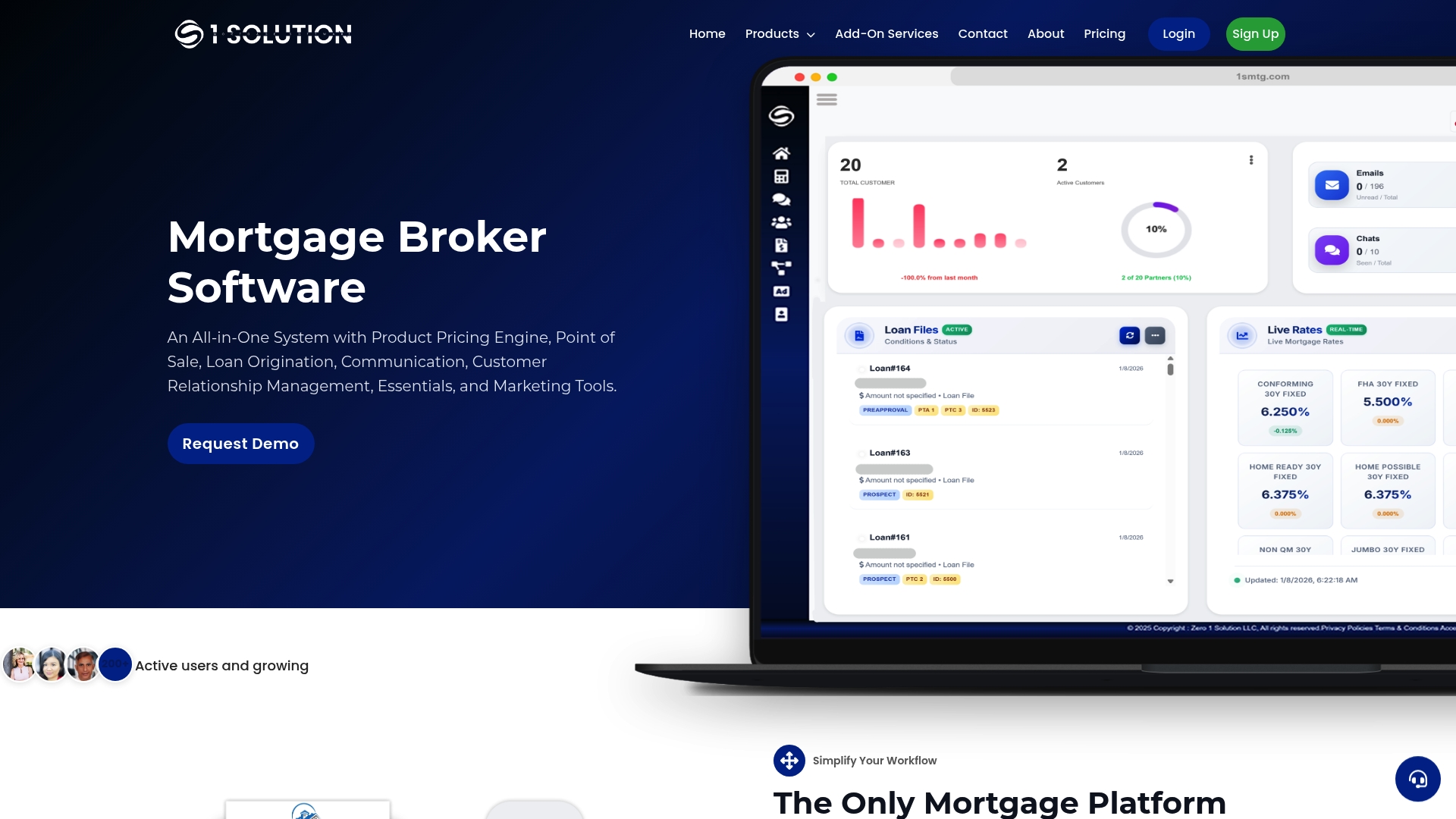
Mapped against the checklist above, our platform gives you:
- A centralized document repository tied directly to our LOS and borrower POS portal, so there is one place a file lives, not five.
- Audit logs that record every change and approval without a manual spreadsheet.
- Retention automation that applies disposition rules by document type instead of relying on staff memory.
- Integrated e-signature and compliance tools so authoritative-copy status updates across the platform the moment a document is signed.
We built this around how brokers actually work, not how a bank's back office does. If stale documents and scattered folders are costing your team rework, see our Subscription Account and full platform features and book a demo to see version tracking running against your own loan files.
FAQ
What does document version control mean?
Document version control means tracking every change made to a file so you always know which copy is current, who changed it, and when. In mortgage lending, it also means designating one copy as the legally authoritative version, particularly for eNotes and security instruments.
What is the best way to version control documents?
The most reliable approach combines a central metadata-driven repository with an immutable audit trail and role-based permissions, rather than relying on file names or folder structures. For mortgage files, pairing this with an authoritative-copy flag and a verifiable profile standard like MISMO SMART Doc V3 adds a layer that confirms document data matches the signed image.
What is document indexing in a mortgage?
Document indexing in a mortgage context means tagging each file with structured metadata, such as document type, loan stage, and effective date, so it can be located and verified quickly during processing, underwriting, or an audit. Indexing works alongside version control: an indexed document still needs a clear version history to be trustworthy.
Can version control be used for documents?
Yes, version control applies to any document that changes over time, and mortgage files are a strong use case because they move through many hands and revisions before closing. The same principles that govern software code repositories, tracked changes, approvals, and audit history, apply directly to loan documentation.
Sources
- FFIEC IT Examination Handbook — Documentation standards
- SMART Doc® Version 3 | MISMO
- CFPB small-entity compliance guide — TILA-RESPA integrated disclosures
- Document retention and version control assessment — Alogent