
A mortgage e-sign workflow is the chain of steps that takes a loan document from your system to the borrower's screen, captures consent and a valid signature, seals the result and files it where an investor or examiner can find it later. It breaks in the handoffs: consent captured after disclosures went out, a signature with no identity trail, an eNote registered a day late. The most reliable fix is to run the whole chain inside one connected system, so consent, signing, storage and the loan file are the same record. That is how we built 1 Solution for independent brokers.
This guide walks the workflow in order, shows where each step goes wrong and what the rules say you must keep.
TL;DR
- Capture eConsent first. Under the federal ESIGN Act, a consumer must consent before electronic disclosures are delivered.
- Each signature needs identity, intent, date and method on record, and Fannie Mae expects that evidence to be retained.
- An eNote must be tamper-sealed and registered on the MERS eRegistry within one business day.
- Most loan documents can be signed electronically, but the promissory note has special handling, and notarization may still apply.
- When consent, signing and the loan file live in one platform, the audit trail builds itself instead of being rebuilt at QC time.
Table of Contents
- The workflow at a glance
- Step 1: Prepare the package
- Step 2: Capture eConsent before anything else
- Step 3: Present each document for review
- Step 4: Sign, and capture the evidence
- Step 5: Seal and file
- Step 6: eNotes, MERS and delivery
- What still needs extra handling
- Step 7: Store it for the long haul
- How the workflow connects to your CRM, POS, LOS and portal
- A quick pre-send and post-sign checklist
- Run it in one place
- Our perspective
- FAQ
- Sources
The workflow at a glance
There are two layers, and brokers often blur them.
The origination layer covers application disclosures, conditions, lender forms and broker-side agreements. It runs under the federal ESIGN Act and the Uniform Electronic Transactions Act (UETA), the state law most states have adopted that gives electronic records the same standing as paper.
The closing layer covers the eNote and security instrument, the tamper seal, MERS registration and delivery to an investor vault. Most of that sits with the lender, closing agent and investor, but the quality of what you send them depends on the origination layer.
Here is the full sequence:
| Step | What happens | What you must be able to show |
|---|---|---|
| 1. Prepare | Package built, documents named and ordered | Correct signers, correct versions |
| 2. Consent | Borrower agrees to electronic delivery | Time-stamped eConsent |
| 3. Present | Borrower reviews each document on screen | Each record shown individually |
| 4. Sign | Identity checked, signature applied | Identity, intent, date, method |
| 5. Seal | Tamper-evident seal applied | Audit trail with no later changes |
| 6. Register and deliver | eNote registered on MERS eRegistry, sent to vault | Registration within one business day |
| 7. Store | Complete package filed with the loan | Retrievable for the life of the loan plus seven years |
Step 1: Prepare the package
Preparation is where most signing errors start. Wrong signer, a co-borrower missing, a stale disclosure version: none of these are signature problems, but each one forces a re-sign after the borrower has already done the work.
Build the package from the loan file, not from a separate folder of PDFs. Confirm every borrower and every required signer is on the file with the right name and email. Our walkthrough on mortgage document packaging covers how to order and name documents so nothing is missed.
If your CRM, POS and LOS are separate subscriptions, preparation usually means re-keying names and contacts between them. That is where typos become signature errors. In our platform the CRM, POS, LOS and e-signature tools sit in one ecosystem, so the borrower record you prepare from is the borrower record you already have.
Step 2: Capture eConsent before anything else
This is the step brokers most often get backwards. Under ESIGN §7001(c), before a consumer receives disclosures electronically, they must affirmatively consent. They must also receive a clear statement of their right to paper, their right to withdraw consent, how to withdraw and update contact details, and how to get a paper copy afterward.
Regulation X confirms the connection: RESPA disclosures may be provided electronically subject to ESIGN's consumer consent provisions. So consent comes before the disclosure package, not alongside it.
FHLBank's eNote guidelines add a practical list of consent elements: what the consent covers, the hardware and software the borrower needs, and a reasonable demonstration that the borrower can actually open the records. They also call for notice and re-consent when system changes create material risk.
Where it goes wrong: consent buried in the same document as the disclosures, or sent as a plain email reply that nobody can later tie to a time and a person. For the full routine, see mortgage eConsent for brokers. For the legal framing, our pieces on ESIGN and UETA and the E-Sign Act and the MERS one-day rule go deeper.

Step 3: Present each document for review
The borrower must see what they sign. The FHLBank guidelines state that the record being signed must be clearly identified, display the borrower's name and be individually presented for review. A single electronic signature cannot be applied to multiple records.
Fannie Mae's Selling Guide says the same thing from the quality side: electronic records must accurately reflect the record as presented to signers. If the borrower signed version 2 but your file holds version 3, you have a problem no audit trail can fix.
Practical checks before sending:
- Every document is final, with the loan number and borrower names correct.
- Each signer sees only the documents and fields that apply to them.
- Signature and initial fields are placed where the form expects them.
- The package opens on a phone, since many borrowers sign from one.
A broker-friendly workflow lets the borrower complete this inside the same portal where they uploaded income documents, with no second login. Our customer portal is built for exactly that kind of single-place experience.
Step 4: Sign, and capture the evidence
The signature itself is the easy part. The evidence around it is what lenders and investors review later.
Fannie Mae requires the seller or servicer to retain, for each electronic signature, evidence of the signer's authenticated identity, attribution to the signer, agreement to sign electronically, the date and the method used, including the e-sign vendor where applicable, sufficient for quality control review.
Freddie Mac's eMortgage Guide describes what a compliant system does at signing: it verifies identity and authority to sign, identifies the signature symbol and its purpose, captures evidence of intent to adopt the signature, shows the printed name and records the time and date.
Where it goes wrong:
- Shared emails. Spouses using one inbox make attribution to the individual signer hard to show.
- Signing links forwarded to a processor or relative.
- No link between identity and signing. Fannie Mae's eNote guide calls for logs that establish a temporal and process link between identity-document presentation and the signing.
For FHA loans, HUD's documentation requirements state that FHA accepts electronic signatures on third-party documents for forward transactions, provided the indication of the signature and date is clearly visible on screen or in a paper copy.
Step 5: Seal and file
Once all signatures are applied, a tamper-evident seal locks the document. Fannie Mae's guidance describes the eClosing system applying this seal as soon as possible after the last signature and keeping a permanent audit trail of changes through closing and registration.
The seal matters in court as well as in underwriting. Holland & Knight explains that storing executed originals in a vault that tracks possession and changes preserves the chain of custody needed to enforce the note, because any change after sealing would not match the audit trail.
For a broker, the practical point is simple: the completed package should drop into the loan file automatically, labeled and complete, not wait in an email attachment. If you want a broader overview of the end-to-end signing process lenders use, this electronic signing process overview lays out the stages.
Step 6: eNotes, MERS and delivery
If the loan closes with an eNote, the clock starts at signing. Fannie Mae's process runs like this: the eNote is signed in an eClosing system, tamper-sealed, registered on the MERS eRegistry within one business day, delivered through MERS eDelivery to the investor's eVault, and then certified and funded if requirements are met.

Freddie Mac's rule is the same in substance: registration as soon as possible, no later than one business day after the closing date, before delivery and certification, with a copy of the authoritative eNote kept in the seller's own vault. FHLBank's MPF program adds that the originating lender is recorded as the first Controller and that missing the window can make a loan ineligible for delivery.
Fannie Mae also notes that an eClosing can be hybrid, with the borrower signing the eNote and non-notarized documents before closing, or a full eClosing with electronic notarization. It does not require the note to be signed on closing day, only that the note date matches the date on the security instrument. Our guide to hybrid eClose mortgages shows what borrowers sign online and what stays in ink.
If you originate through wholesale lenders, the eNote and registration usually sit on the lender's and closing agent's side. Your job is to deliver a clean, fully consented, correctly signed file so nothing stalls before they reach that step. See mortgage file submission for that handoff.
What still needs extra handling
Not every document follows the simple path. Fannie Mae's Selling Guide allows documents used to originate, service or modify a loan to be signed and stored electronically if they can be reproduced in paper, with exceptions: the promissory note and related addenda (unless the seller is approved for eNotes), unrecorded ink-signed originals that modify the security instrument, and certain MERS assignments where MERS is not the nominee.
Remote online notarization adds its own checks. FHLBank Chicago tells members to verify that systems use at least two-factor identity authentication, including a government-issued photo ID and credential analysis. The notary then attaches an electronic signature, seal and digital certificate, making the document tamper-evident, as Holland & Knight describes.
Your investor's overlay and your state's rules decide the rest. Confirm with the investor and your compliance officer before you promise a borrower a fully electronic closing.
Step 7: Store it for the long haul
Storage is a compliance step, not housekeeping. Fannie Mae requires files and audit trails to be kept for the life of the loan plus seven years, produced in a compatible format on request and handed to a new servicer at servicing transfer. Retained files must show each signer's name, the date of each signature, the method used and information that verifies attribution.
The federal rule behind it: an electronic record satisfies a retention requirement only if it accurately reflects the information in the original and stays accessible to everyone entitled to it, in a form that can be reproduced later.
Two habits keep you safe:
- Link every signed package to the loan, not to a person's inbox. Fannie Mae expects electronic loan files to be logically associated with its loan number.
- Keep the consent, the audit trail and the signed documents together. An examiner asking about one will ask about all three.
Freddie Mac also requires that borrowers get a paper copy of the eNote and documents unless they agree in writing or electronically to receive electronic copies, another reason consent belongs on file.
How the workflow connects to your CRM, POS, LOS and portal
This is where most brokers lose time. A signing tool bolted onto separate systems means four handoffs: the CRM holds the contact, the POS holds the application, the LOS holds the loan and the signing tool holds the evidence. Each handoff is a re-key, an export or an email.
A connected workflow reverses that:
- The lead and borrower contact live in the CRM from first touch.
- The borrower applies and uploads documents in the POS portal.
- eConsent and disclosures go out from the same record.
- The signed package files to the loan in the LOS, with document storage attached.
- Status messages reach the borrower by email, SMS, chat, voice or video from the same place.
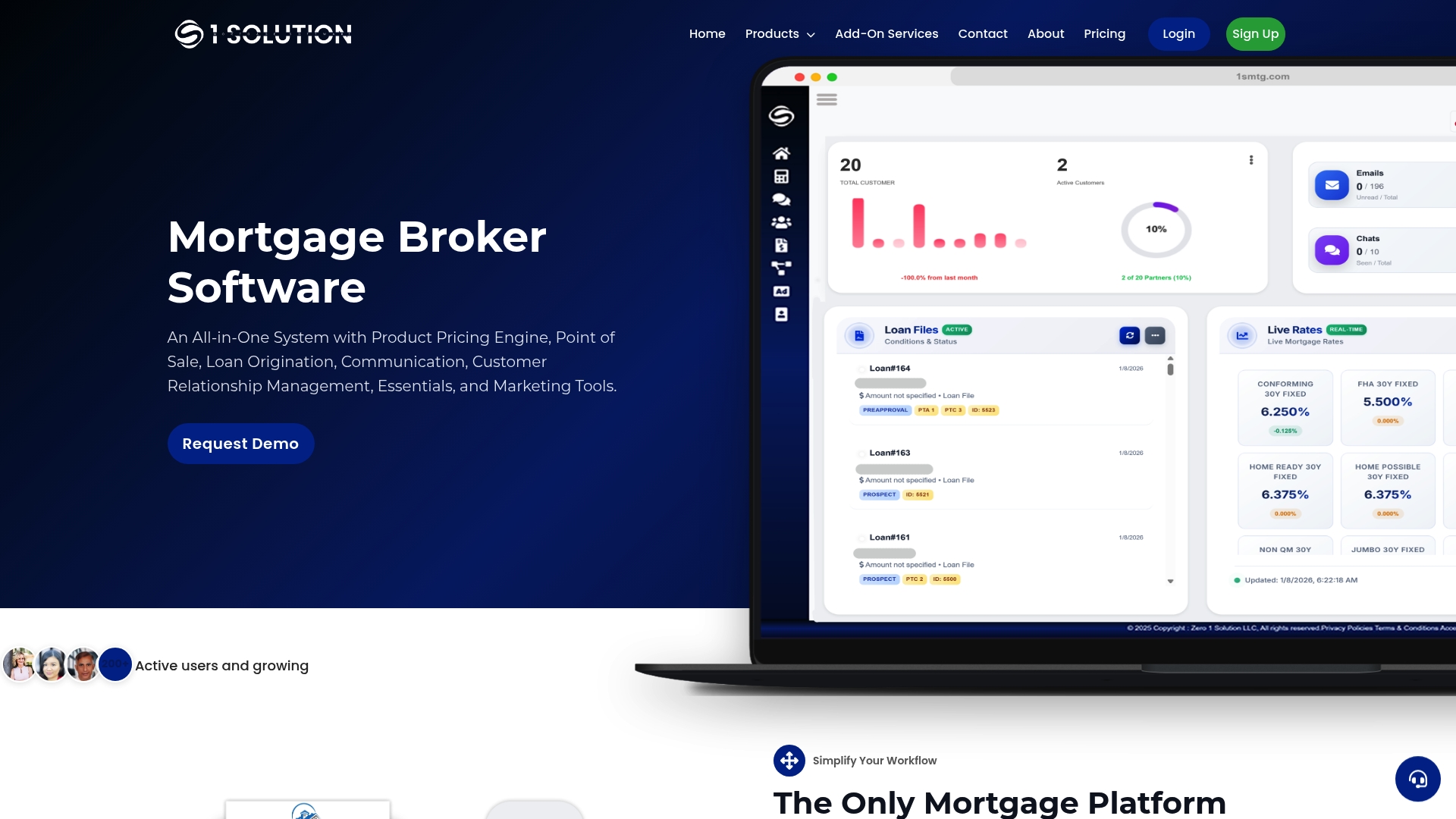
That is the design of 1 Solution: pricing, CRM, communication, POS, LOS, compliance, marketing and operational tools in one connected ecosystem. If you are replacing several subscriptions, our look at e-signature costs for mortgage companies shows where per-envelope and per-seat fees add up, and the overview of alternatives helps when you are weighing a switch. For redesigning the whole office around it, see new mortgage office workflow design and how digital mortgage applications work.
A quick pre-send and post-sign checklist
Before sending
- eConsent is on file and time-stamped.
- Names, emails and signer roles match the loan file.
- Each document is the final version and individually presented.
- Documents that need ink or notarization are flagged.
After signing
- Identity, intent, date and method are recorded for each signer.
- The completed package is sealed and filed to the loan.
- If an eNote is involved, registration is on track for the one-business-day window.
- The audit trail is stored with the documents.
Run it in one place
If you handle consent, signing, portal, CRM and loan file through separate vendors, you carry the integration work yourself. 1 Solution is a cloud-based platform for brokers and lenders that brings LOS, CRM, POS, e-signature, compliance, communication tools, document storage and a customer portal together, with personalized onboarding. Usage fees are published: $0.10 per text message sent or received, $0.10 per phone minute and $0.10 per fax sent or received. Subscription pricing is not published, so request a quote on our site.
Our perspective
We built 1 Solution after more than 20 years in mortgage operations as a processor, underwriter, loan originator and systems consultant. The same failure shows up again and again: the signing step is fine, and everything around it is scattered.
Brokers pay for a CRM, a POS, an LOS and a signing tool, then spend their days moving data between them. Every move is a chance to lose consent, mismatch a version or leave an audit trail in someone's inbox. Platforms designed primarily for banks and direct lenders rarely treat that as their problem.
That is why we are independent and self-funded, with no outside investors steering the roadmap. We put the workflow in one place so the broker controls it: consent, disclosures, signatures, storage and communication tied to the same loan. Our view is that compliance is easier to show when it is a by-product of how the work gets done.
Omar Khamisa
FAQ
Is an electronic signature legally valid on mortgage documents?
Generally yes. The federal ESIGN Act says a signature or contract cannot be denied legal effect solely because it is electronic. Freddie Mac adds that electronic loan documents must also comply with the UETA version enacted in the applicable state. Your investor's rules still apply on top.
Do I need eConsent for every borrower?
Yes, each consumer who receives disclosures electronically must consent first. Each co-borrower should consent individually, with the consent time-stamped and filed with the loan. See our eConsent guide for the routine.
How long does an eNote have to be registered with MERS?
Freddie Mac and the FHLBank MPF program both set it at as soon as possible, and no later than one business day. Fannie Mae's process uses the same one-business-day window. Registration comes before delivery to the investor and certification.
How long do I keep e-sign records?
Fannie Mae requires retaining files and audit trails for the life of the loan plus seven years. Keep identity evidence, signing method, dates and consent with the signed documents.
Can the whole closing be electronic?
Sometimes. Fannie Mae describes both hybrid closings and full eClosings with electronic notarization. The promissory note has special handling unless eNotes are approved, so confirm with your investor before promising a borrower a fully digital closing.
Sources
- U.S. Code Title 15, ESIGN Act (govinfo.gov)
- Regulation X, 12 CFR Part 1024 (govinfo.gov)
- FHLBank eNote collateral guidelines
- Fannie Mae Selling Guide A2-4.1-03
- Fannie Mae Selling Guide B8-8-02
- Freddie Mac eMortgage Guide
- Freddie Mac Electronic Loan Documents FAQ
- Fannie Mae eClosings and eMortgages FAQ
- Fannie Mae eMortgage Solutions and eNotes
- Fannie Mae, How to Implement eMortgages
- HUD Form 4155-1, Section B
- FHLBank MPF Exhibit DD
- FHLBank Chicago eNote acceptance requirements
- Holland & Knight, Remote Online Notarization in Mortgage Loan Closings
- OMB E-SIGN Act guidance
- Electronic signing process overview