
A pipeline SLA in mortgage is a time commitment attached to one stage of a loan file: how long a task may take, who owns it, and what happens when the clock runs out. Done well, it turns a vague promise to "get this closed fast" into a set of small, measurable handoffs that a broker owner, processor, or loan officer can actually manage.
This guide shows what an SLA means in practice, where the clocks belong in a loan pipeline, sample targets you can adapt, the regulatory deadlines that override anything you set internally, and how to monitor misses before the borrower feels them.
TL;DR
- A pipeline SLA is a stage-level time limit with a named owner. Fannie Mae's own tools show the model: each task has a time frame, and items are flagged as within, near, or outside SLA.
- Put clocks on handoffs (intake, processing, underwriting, conditions, closing), not on the loan as a whole.
- Internal targets never override federal timing rules such as the Loan Estimate and Closing Disclosure deadlines.
- Faster is not free or automatic: STRATMOR's data shows the quickest lenders spent more per loan, so set targets your staffing can actually meet.
- Track "near SLA" items daily so you fix delays before they become misses.
Table of Contents
- What a pipeline SLA means in mortgage lending
- Where the clocks belong in the pipeline
- Sample targets by stage
- How to set targets your team can actually hit
- Compliance clocks that override your internal SLAs
- Monitoring misses, escalating delays, and keeping borrowers informed
- Our perspective: SLAs fail when the tools are scattered
- Run your pipeline clocks in one place
- Putting it into practice this month
- FAQ
- Sources
What a pipeline SLA means in mortgage lending
In the broad sense, a service level agreement is a promise about speed and quality of service. In mortgage operations it shows up in two ways: as a commitment between parties (lender and broker, processor and loan officer, your company and a vendor) and as an internal standard for how long a file may sit in a stage.
The clearest primary-source example comes from Fannie Mae. In its Loan Quality Connect tool, an SLA is the number of days allowed to respond to or complete a request, each task has its own time frame, and items are shown as within, near, or outside SLA. In Fannie Mae's example thresholds, an item is Near SLA when 50% or less of the allotted time remains, and Outside SLA once the original due date has passed.

That three-state model is worth borrowing, whatever system you use. It gives your team a yellow zone, not just a red one. A file that is "near SLA" is still recoverable. A file outside SLA already has a cost.
Two things make an SLA real rather than decorative:
- A clock with a start and a stop. "Underwriting turn time" means nothing until you define when it starts (complete submission received?) and stops (decision issued?).
- An owner. Someone's name, not a department, sits next to the clock.
Where the clocks belong in the pipeline
A loan moves through a chain of roles, and every handoff is a place where files wait. Freddie Mac's consumer guide names the principal roles as loan officer, processor, underwriter, appraiser, and closing representative. The processor prepares and checks the file for underwriting, and the underwriter makes the eligibility decision. Closing is the final step, requiring execution of the note and security instrument and completion of the required insurance, inspection, and funds-related items.
That description maps cleanly to ownership. Ownership should follow the handoff:
- Loan officer: owns a complete, accurate application and the initial borrower conversation.
- Processor: owns file completeness before it goes to underwriting.
- Underwriter: owns the credit decision and clear, complete conditions.
- Closing coordinator: owns final execution, funds, and the last borrower communication.
For brokers, an extra layer sits on top: the wholesale lender's own turn times on submission, underwriting, and closing documents. Your internal SLAs should be built around those, since you cannot promise a borrower what your lender partner cannot deliver. If you are still shaping roles, our guide to mortgage team structure for brokers covers who should own which handoff, and mortgage file submission explains how to hand a clean file to the lender in the first place.
The stages worth putting a clock on
You do not need an SLA for every task. Start with the points where files most often stall:
- Application received to disclosures sent
- Submission to initial underwriting review
- Conditions issued to conditions cleared
- Final underwriting decision
- Clear to close to documents out
- Documents out to closing
Six clocks are enough to begin. Add more only when your data shows another recurring bottleneck.
Sample targets by stage
Published targets are hard to find because most are internal. One useful reference is the workflow LenderMAC publishes for its U.S. wholesale channel. Its stage targets run as follows: up to one day for setup and initial disclosure, up to two days for initial underwriting and conditional review, one day for final underwriting, same day for a locked Loan Estimate and initial Closing Disclosure, and up to two days for documents out and closing.
That is one lender's wholesale process, not an industry rule. Use it as a starting frame, then adjust for your own volume, product mix, and lender partners.
| Stage | Sample target (one wholesale workflow) | Suggested internal owner | Suggested "near SLA" trigger |
|---|---|---|---|
| Setup and initial disclosure | Up to 1 day | Loan officer or processor | Half the time used |
| Initial underwriting and conditional review | Up to 2 days | Underwriter (lender side) | 1 day elapsed |
| Final underwriting | 1 day | Underwriter | Half the day used |
| Locked Loan Estimate and initial Closing Disclosure | Same day | Processor or closer | Any lag after lock |
| Documents out and closing | Up to 2 days | Closing coordinator | 1 day elapsed |
The "near SLA" column applies the Fannie Mae half-time-remaining idea to each stage. It is our suggestion, not a published standard.
Add performance expectations for people, not just files
Stage clocks measure the file. You also need expectations for the person handling it. MBA NewsLink recommends quantifiable expectations for processors, underwriters, closers, and post-close staff, including files handled, underwriting decisions per day, task accuracy, decision time, document-delivery timing, and follow-up on undelivered documents.
The same source separates three management layers worth keeping distinct: measurable goals, process-stage expectations, and documented procedures. It argues that clearer standards improve performance when staff have adequate resources. The last part matters. A standard without capacity behind it is just pressure.
How to set targets your team can actually hit
The most common SLA mistake is copying an aggressive number from a competitor's marketing and then missing it every week. Work from your own data.
Step 1: Measure the current state
Pull 60 to 90 days of closed files and record the actual time in each stage. Use the median and the 80th percentile, not just the average. An average hides the files that wrecked a borrower's contract deadline.
Step 2: Know the market benchmark, then ignore it
MBA NewsLink reported that Ellie Mae's October 2020 data showed an average time to close of 54 days, with refinances averaging 57 days and purchases 48 days. That was a high-volume period, and cycle times move with volume. The point of a benchmark is context, not a target. Your target is what your team, your lenders, and your borrowers' contract dates require.
Step 3: Weigh speed against cost
In the same MBA NewsLink piece, STRATMOR analysis found the fastest-cycle quartile averaged 33 days from application to closing versus 44 days for the slowest, and the faster group spent $430 more per loan. Speed has a price, usually in staffing, technology, and process discipline. Decide what that price buys you: referral partner loyalty, higher pull-through, fewer lost purchases.
Step 4: Write the SLA in one sentence
A usable SLA reads like this: "Conditions cleared within one business day of receipt by the processor, who notifies the loan officer if a condition needs the borrower." It names the stage, the time, the owner, and the escalation. If it takes a paragraph to explain, it will not be followed.
Step 5: Define exceptions up front
Some delays are not your team's fault: a borrower who takes four days to send a paystub, an appraisal that comes back late, a lender that changes guidelines. Decide in advance which causes pause the clock and who documents the reason. Otherwise every miss becomes an argument.
Compliance clocks that override your internal SLAs
Internal targets live below regulatory deadlines. Build the legal timing into the pipeline first, then fit your service targets around it. This is general information on federal rules, not legal advice: have your compliance officer or counsel confirm how they apply to your loans and your state.
- Loan Estimate. The CFPB states that for a covered mortgage application, the Loan Estimate is generally due within three business days after the lender receives the borrower's name, income, Social Security number, property address, estimated property value, and requested loan amount. That makes "same day" disclosure a sensible internal SLA, since it leaves margin.
- Closing Disclosure. The lender must provide it at least three business days before closing, giving the borrower time to compare final terms and costs and ask questions. Your "documents out" SLA has to sit comfortably inside that window.
- Corrected disclosures. Per the CFPB's TRID FAQ, a corrected Closing Disclosure triggers a new three-business-day waiting period when the change makes the APR inaccurate, makes required loan-product information inaccurate, or adds a prepayment penalty.
That last rule is why late changes are so expensive. A rushed fix to a closing figure can push a closing date by days. Add an SLA for "changes after clear to close": who approves them, who re-checks the disclosure, and how the closing date is reconfirmed with the borrower and the agent.
Monitoring misses, escalating delays, and keeping borrowers informed
An SLA nobody watches is a wish. Fannie Mae's guidance for its own tool is to maintain the pipeline so loans are addressed before SLA expiry, and to avoid or quickly resolve loans that exceed it. Translate that into three habits.
A daily pipeline review focused on "near SLA"
Every morning, sort files by time remaining in their current stage, not by loan amount or by loan officer. The ten minutes this takes will catch most problems. Look for files with no activity, outstanding conditions older than a day, and anything within a few days of a rate lock expiration or contract deadline.
A simple escalation ladder
- Near SLA: the owner gets an automatic reminder and the task stays with them.
- Outside SLA: the owner's lead or branch manager is notified and decides on reassignment or a call to the lender.
- Outside SLA plus a hard deadline at risk (lock expiration, contract date, disclosure timing): the owner of the brokerage is informed and the borrower and referral partner hear from us the same day.
Write the ladder down. When people know exactly when a problem becomes someone else's problem, they raise it sooner.
Tell the borrower before they ask
Most of the damage from a delay is not the delay itself but the silence around it. Our piece on why miscommunication delays closings covers this in detail. The short version: set a communication SLA alongside the processing SLA. For example, every borrower with an open condition hears from you at least once a day until it is cleared, through whichever channel they answer (text, email, portal message).
A borrower portal helps because the borrower can see what is outstanding, so "where are we?" calls drop. The structure of the first week matters too, and our borrower onboarding workflow guide shows how to front-load documents so the first stage clock is not wasted waiting.
Review the numbers monthly
Once a month, look at four things: percentage of files finishing each stage within SLA, the top three causes of misses, which handoff has the longest median wait, and how many files needed a corrected disclosure. Our mortgage broker efficiency metrics guide goes deeper on which numbers matter. If one stage misses constantly, the answer is usually capacity or a broken handoff, not a lecture.
Our perspective: SLAs fail when the tools are scattered
We have heard the same story from brokers for years. The SLA is fine on paper. The trouble is that the file lives in five places: the LOS in one tab, a CRM in another, a separate e-sign tool, a texting app on someone's personal phone, and a spreadsheet the processor keeps because nothing else shows what is waiting on whom. No clock can run across that. Someone has to hunt for the status, and the hunt is the delay.
That is the frustration we built 1 Solution to fix. After more than 20 years as a processor, underwriter, loan originator, and systems consultant, I know that most pipeline problems are handoff problems. A file sits because the next person does not know it is theirs. So our advice is plain:
- Put the stage, the owner, and the due date on the file itself, where everyone on the team sees it.
- Keep communication attached to the loan, not scattered across personal inboxes and phones.
- Choose SLAs you can staff. A target you miss every week teaches your team that targets do not matter.
- Stay in control of your own process. Brokers should decide their workflow, not bend around software designed for banks and direct lenders.
We are self-funded and independent, so we answer to brokers, not investors. That is why we design around how independent offices really work.
— Omar Khamisa
Run your pipeline clocks in one place
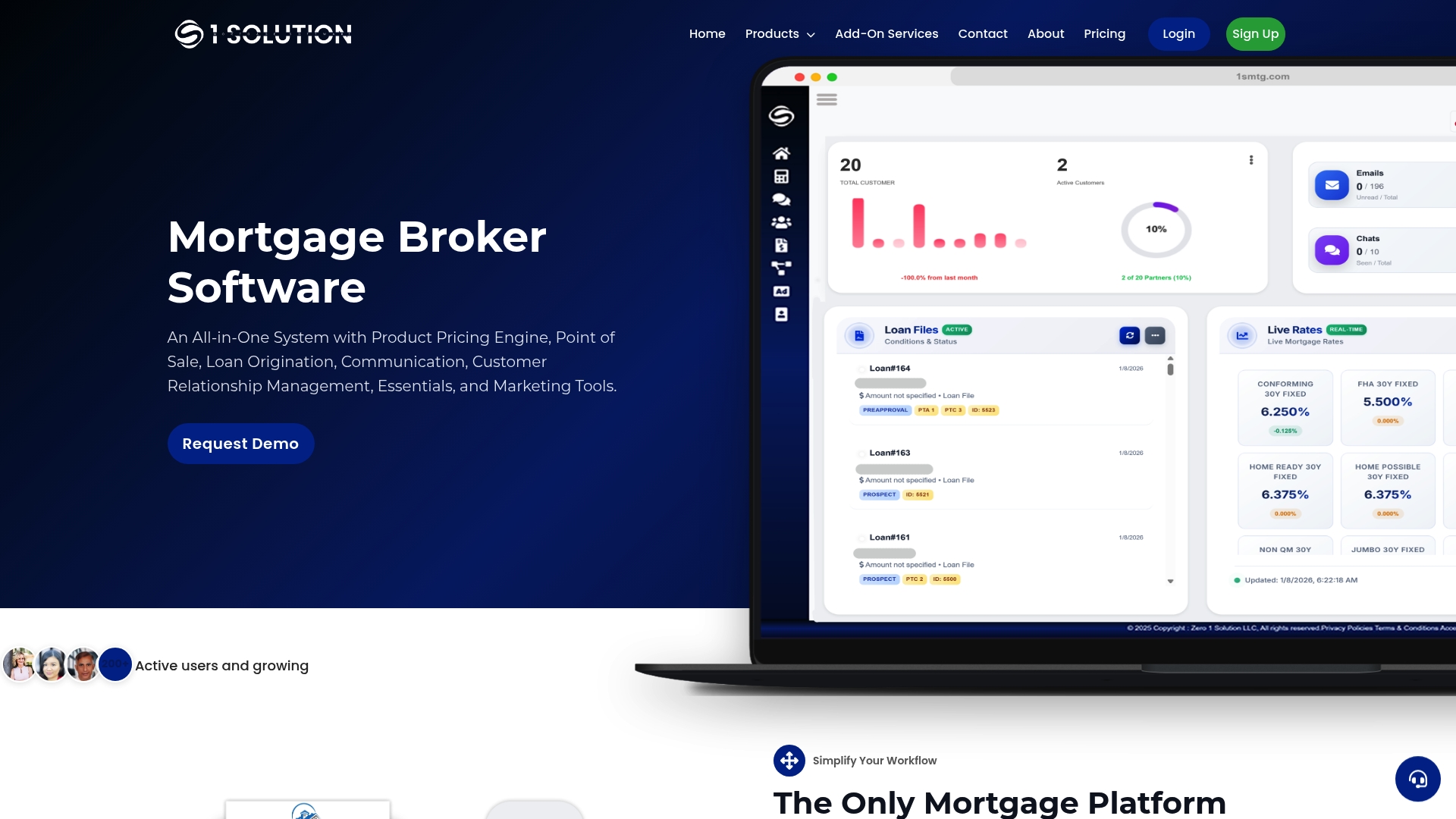
If you are tracking stage targets across disconnected tools, 1 Solution brings the pipeline into one platform: LOS, CRM, borrower POS portal, e-signature, compliance tools, and communication by email, SMS, chat, voice, and video. Because messages, documents, and tasks stay attached to the loan, your team can see where a file sits and who owns the next step without chasing.
Usage-based communication fees are published: $0.10 per minute for the phone system, and $0.10 per text message sent or received. Subscription pricing is not published, so reach out through our site for a walkthrough and a plan that fits your team. Our onboarding is personalized, and real people support you after launch. If you want to see how the pieces fit before you commit, our guide to new mortgage office workflow design lays out the thinking.
Putting it into practice this month
You can start without new software. Here is a realistic first month:
- Week 1: Pull data from the last 60 to 90 closed files. Calculate median and 80th percentile time in each of the six stages.
- Week 2: Draft one-sentence SLAs for each stage. Name an owner for each. Share them with the team and the lenders you submit to, and ask where they are unrealistic.
- Week 3: Start the daily near-SLA review. Log every miss with a cause.
- Week 4: Review the log. Fix the biggest cause first, whether that is a missing document checklist, a slow handoff, or a lender that consistently takes longer than your promise allows.
If closings are the weakest link, read about closing coordination systems. If you want to shorten the whole cycle, how to speed up your loan approval process covers practical steps. And if your team's slow spots are about software adoption, see how loan officers get trained on software.
For the bigger picture of how an office runs day to day, mortgage broker operations explained is a good companion.
FAQ
What is a pipeline SLA in mortgage?
It is a defined time limit for completing a task or stage on a loan file, tied to a named owner. Fannie Mae's Loan Quality Connect tool uses the same idea, with each task given a number of days and items flagged as within, near, or outside SLA. In a brokerage, the same logic applies to handoffs between loan officer, processor, underwriter, and closer.
What turnaround times should I use for each stage?
Start from your own closed-file data, then compare with a published workflow. One U.S. wholesale lender lists up to one day for setup and disclosure, up to two days for initial underwriting, one day for final underwriting, and up to two days for documents out and closing. Treat those as a reference point and adjust for your volume and lender partners.
Do SLAs replace TRID deadlines?
No. The Loan Estimate and Closing Disclosure timing comes from federal rules, and your internal targets should sit inside them with margin. A corrected Closing Disclosure can restart a three-business-day wait in specific cases, so late changes deserve their own approval step. Confirm the details with your compliance officer or counsel.
How do I escalate a file that is outside SLA?
Use a written ladder: the owner is reminded when a file is near SLA, their lead is notified when it is outside SLA, and the brokerage owner and borrower are informed the same day when a hard deadline is at risk. Record the cause of every miss so you can fix the pattern, not just the file.
Is a faster pipeline always better?
Not automatically. STRATMOR's analysis reported through MBA NewsLink found the fastest-cycle lenders closed in 33 days but spent $430 more per loan than the slowest. Faster cycle times usually need more capacity or better process, so set targets your team can staff and sustain.
Sources
- Service Level Agreements (SLAs), Fannie Mae Loan Quality Connect
- Your Step-by-Step Mortgage Guide, Freddie Mac
- Toolbox, LenderMAC
- Jim Cameron: Balance is Key for Managing Capacity and Cycle Times, MBA NewsLink
- Bob Mansur: What are Your Production Expectations, MBA NewsLink
- What is a Closing Disclosure?, CFPB
- Loan Estimate and Closing Disclosure: Your guides as you choose the right home loan, CFPB
- TILA-RESPA Integrated Disclosure FAQs, CFPB